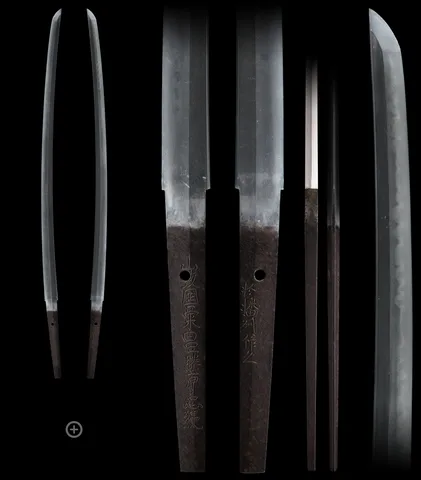
Awataguchi Tadatsuna
粟田口忠綱 (Awataguchi Tadatsuna)
Lineage: the signature does not state the generation
Osaka lineage of swordsmiths from Himeji in Harima, active from the mid-17th to the early 18th century.
Profile
A lineage of Osaka swordsmiths of the Asai (浅井) family who signed with the name Awataguchi (粟田口) and claimed descent from Awataguchi Kunitsuna (粟田口国綱), a Kamakura-period smith of Kyoto; the claim has never been proven. The first generation worked in Himeji, in Harima, and around the middle of the 17th century moved to Osaka, where he received the title Ōmi no Kami (近江守). His son, the second generation, received the same title and from the Genroku era also signed as Ikkanshi (一竿子); his known work spans the 1670s to the 1710s. Both signed Awataguchi Ōmi no Kami Tadatsuna. The first worked mainly in ashinaga-chōji, clove-shaped chōji with long legs; the second began in the same manner and around Genroku moved to the broad, wave-like tōran-midare of the Osaka smiths. He carved his own horimono (dragons, plum trees, waterfalls) and marked them by adding hori dōsaku (彫同作) to the signature. A tachi of 1709 in the Kyoto National Museum is designated an Important Cultural Property, and the Hikone Castle Museum holds another blade dated 1713.
Swords available
-
Awataguchi Fujiwara Tadanawa
An early signature of the first Tadatsuna, while he still signed “Tadanawa”. Well-kept tang with a single mekugi-ana, koshirae and shirasaya. NBTHK Tokubetsu Hozon. Katana signed “Awataguchi Fujiwara Tadanawa”: the early signature of the first Tadatsuna, before he adopted the name by which he is known. He had been born in Himeji, in Harima, and the “Yamashiro no Kuni” that appears in the signature indicates that by then he had moved away and returned to his native province to forge this blade. The original seller regards it as a representative work of his maturity and points out that without this first Tadatsuna there would be no Ikkanshi of the second generation. The blade belongs to the early Edo period and measures 66.4 cm nagasa with 1.5 cm sori. The tang is well kept, with a long signature in a distinctive hand, and retains a single mekugi-ana. It is sold with koshirae and shirasaya, and with NBTHK Tokubetsu Hozon papers.
52.9/100
€9,090