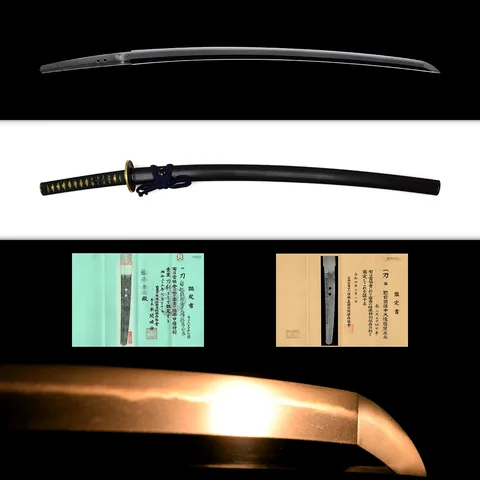
Bitchū Daijō Masanaga
備中大掾正永 (Bitchū Daijō Masanaga)
Hizen swordsmith of the Masahiro line within the Tadayoshi school, active in the second half of the 17th century.
Profile
Masanaga worked in Saga, in Hizen province, in the Masahiro (正広) branch of the school founded by Tadayoshi (忠吉). He was the eldest son of the second Masahiro, Kawachi no Kami. School tradition holds that he went with his father to Kyoto, where he was granted the title Bitchū Daijō (備中大掾) during the Kanbun era. On his father's death he became head of the family as the third generation of the line, yet, as Fujishiro's reference work notes, he always signed Masanaga and never Masahiro. His long signature reads Hizen no Kuni Bitchū Daijō Fujiwara Masanaga (肥前國備中大掾藤原正永). He is thought to have spent much of his career forging as a stand-in for his father, on blades bearing the father's name, which would account for the small number signed with his own. His work follows the Hizen manner: a fine, tight konuka-hada (小糠肌) and a nie-based hamon, either suguha or notare mixed with gunome.
Rankings
- Wazamono (good) (Kaihō Kenjaku, 1797)
Swords available
-
Hizen Bitchū Daijō Fujiwara Masanaga
Shintō blade from Hizen, Enpō era, with an ubu tang, kuro-ishime-nuri koshirae, shirasaya and tsunagi. NBTHK Tokubetsu Hozon plus an older Kōshu Tokubetsu Kichō Tōken paper. Signed 肥前國備中大掾藤原正永 (Hizen no Kuni Bitchū Daijō Fujiwara Masanaga), this shintō blade from Hizen belongs to the Enpō era, from 1673 onwards. Bitchū Daijō Masanaga was the eldest son of the second Kawachi no Kami Masahiro; known in civil life as Denbei, he first signed “Hironaga”. He went up to the capital with his father in 1665 and received the title of Bitchū Daijō. In 1699 he inherited the headship of the Masahiro house of Hizen and in 1701 petitioned for a change of title, but died in 1704 at the age of sixty before the matter was settled, so he never signed “Masahiro”. Works bearing his own signature are not plentiful, since he spent most of his career producing daisaku-daimei for the second Masahiro. The blade measures 71.0 cm nagasa with 1.97 cm sori and a good taper from motohaba (33.3 mm) to sakihaba (26.5 mm at the monouchi), with an elongated point; it weighs 858 g bare and 1,132 g mounted. The hada is a tight ko-itame with fine, dense ji-nie and small chikei, the refined Hizen ji-gane, while the suguha is luminous, with fine sunagashi, kinsuji, inazuma and gunome ashi; the bōshi is straight with a round turnback. The tang is ubu, with two mekugi-ana.
64.8/100
€12,560