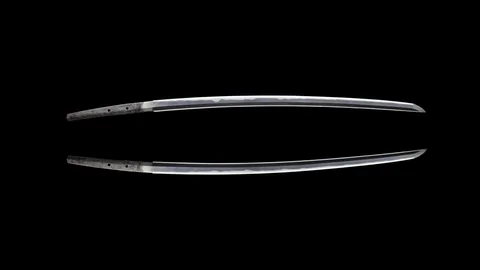
Dewa Daijō Kunimichi
出羽大掾国路 (Dewa Daijō Kunimichi)
Swordsmith of Kyoto, in Yamashiro, a pupil of Horikawa Kunihiro, active from 1608 into the early 1660s.
Profile
Kunimichi was born around 1576 and worked in Kyoto. He trained first under Iga no Kami Kinmichi of the Mishina school and then joined the workshop of Horikawa Kunihiro, where he is generally regarded as the foremost pupil. His earliest known works, from 1608, are signed with the characters 国道 (Kunimichi); soon afterwards he changed to 国路 (Kunimichi), and between 1613 and 1615 he received the honorary title Dewa Daijō, signing thereafter Dewa Daijō Fujiwara Kunimichi. Dated works run into the early 1660s, a career of more than fifty years. He was the most versatile smith of the Horikawa group, though his preferred idiom was Sōshū-den after the models of Sadamune, Shizu and Samonji: itame with plentiful ji-nie and chikei, masame in the shinogi-ji, a gunome midare hamon in nie with kinsuji and sunagashi, and a Mishina-type bōshi. Yasaka Shrine in Kyoto holds a tachi by him dedicated in 1654, with fittings by Taiami, designated an Important Cultural Property.
Rankings
- Wazamono (good) (Kaihō Kenjaku, 1797)
Swords available
-
Dewa Daijō Fujiwara Kunimichi
Shintō katana signed by Dewa Daijō Fujiwara Kunimichi, of the Horikawa school of Yamashiro, with an NBTHK Tokubetsu Hozon Tōken certificate. It comes in a modern black-lacquer koshirae and with a shirasaya. Katana signed by Dewa Daijō Fujiwara Kunimichi, a master of Yamashiro province trained in Kunihiro's Horikawa school and active during the first decades of the Edo period. The blade measures 63.6 cm nagasa with 1.4 cm sori; the photographs show an undulating hamon with visible nie and a well-preserved kissaki. The nakago keeps its original end and bears the mei on the omote, with no date on the ura; it has two mekugi-ana and, judging by the spacing between them, the photographs point to machi-okuri. An NBTHK Tokubetsu Hozon Tōken certificate is photographed alongside the piece, together with a shirasaya bearing an ink inscription. The mounting is a replacement koshirae: recent black-lacquer saya, tsuka with black ito over same and menuki of fishing gear, dragon-motif fuchi-kashira and a plain circular iron tsuba. The original seller warns of a couple of kitae-kizu on the blade.
43.3/100
€11,020