Hōki no Kami Hirotaka
伯耆守汎隆 (Hōki no Kami Hirotaka)
Echizen swordsmith of the Echizen Seki line who held the titles Hōki Daijō and Hōki no Kami, active around the middle of the 17th century.
Profile
Hirotaka was an Echizen swordsmith of the early Edo period, part of the shintō era. He is placed in the Echizen Seki line, smiths of Mino descent who settled in the province, and is regarded as a student of Kanetane (兼植), although some reference works link him instead to the Shimosaka workshop. He first received the title Hōki Daijō and later Hōki no Kami, and signed in several forms, among them Hōki Daijō Hirotaka, Hōki no Kami Fujiwara Hirotaka and Echizen-jū Hōki no Kami Fujiwara Hirotaka. The smith directories record more than one generation under this name, and there are works dated to the Meireki era (1655-1658). His jigane is usually a fine, tightly forged itame; the hamon, in nie-deki, mixes gunome midare with pointed elements and at times notare, close to the work of his contemporary Harima Daijō Shigetaka, with whom collaborative blades are known. His output was large, with many signed blades and unsigned ones attributed to him, and he counts among the representative names of Echizen shintō.
Rankings
- Wazamono (good) (Kaihō Kenjaku, 1797)
Swords available
-
Echizen-jū Hōki no Kami Fujiwara Hirotaka
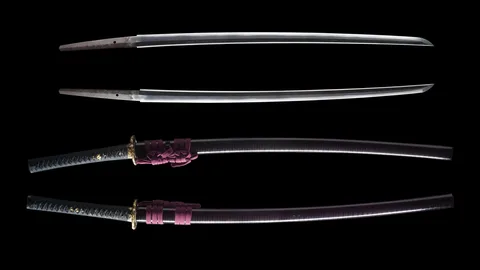
Shintō blade of the Echizen Shimosaka school by a smith ranked wazamono. 71.6 cm nagasa, with purple-lacquered koshirae and shirasaya. NBTHK Tokubetsu Hozon. Katana signed “Echizen-jū Hōki no Kami Fujiwara Hirotaka” (越前住伯耆守藤原汎隆). Hirotaka is one of the leading names of the Echizen Shimosaka school and trained under Kanetane, among the most celebrated smiths of the province; the title of Hōki no Kami was granted only to craftsmen of standing. He is further ranked as wazamono, the category of smiths whose blades were tested and certified as especially sharp. Echizen prospered under the Matsudaira, direct kin of the Tokugawa, and drew many Mino smiths — Hirotaka's master among them — known collectively as Echizen Seki: hence the togari, the peaks rising out of the hamon, a Mino-den trait. The blade measures 71.6 cm nagasa with 1.06 cm sori. The photographs show a clean tang, signed on both faces and with a single mekugi-ana, features of an ubu tang; the frames devoted to kizu reveal no flaws. It is supplied with NBTHK Tokubetsu Hozon papers, shirasaya and a koshirae with purple saya and gilt tsuba, together with a carrying case and a maintenance kit.
60.3/100
€12,310