Osafune Kiyomitsu
長船清光 (Osafune Kiyomitsu)
Lineage: the signature does not state the generation
Lineage of Osafune smiths in Bizen who signed Kiyomitsu throughout the 16th century, within the Sue-Bizen group.
Profile
Kiyomitsu is a name signed by several generations of Osafune smiths in Bizen during the later Muromachi period. Their work belongs to what is known as Sue-Bizen and survives in large numbers: among blades of that time, only those of Sukesada are more common. Two holders of the name stand out: Gorōzaemon-no-jō Kiyomitsu (五郎左衛門尉清光), with dated work from the Tenbun era (1532-1555), and Magoemon-no-jō Kiyomitsu (孫右衛門尉清光), active in the Eiroku era (1558-1570), whom school tradition regards as the son of the former. The ordinary signature read Bizen no kuni-jū Osafune Kiyomitsu or Bishū Osafune Kiyomitsu; on commissioned work the smith added his personal name, and further personal names appear down to the Tenshō era. Besides the gunome and chōji typical of Sue-Bizen, the line is credited with a carefully made suguha, at times broken by stretches of kuichigai-ba, and a faint utsuri. It should not be confused with the Kiyomitsu of Kaga (加州清光, Kashū Kiyomitsu), a separate line based in Kanazawa.
Swords available
-
Osafune Kiyomitsu
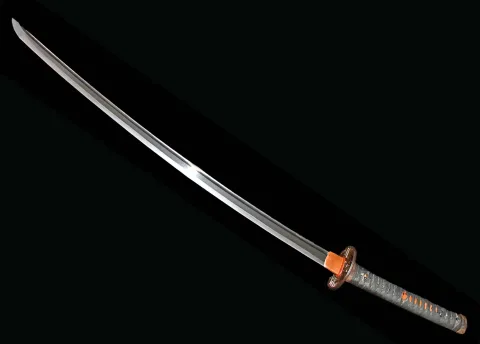
Bizen Osafune katana signed by Kiyomitsu and dated the 2nd month of Tenbun 22 (1553), with Tokubetsu Hozon papers and a complete mounting shown in the photographs. Katana of the Osafune school of Bizen province by Kiyomitsu, one of the best-known names of mid-Muromachi Sue-Bizen. Based on the date and workmanship, the original seller attributes it to Gorōzaemon-no-jō Kiyomitsu. The blade has a nagasa of 70.0 cm with 2.6 cm of sori, a motohaba of 3.15 cm and a sakihaba of 2.38 cm; its 0.9 cm motokasane makes it, in the original seller's words, a robust blade. The photographs show a medium kissaki and bōhi on both sides. The nakago bears the signature "Bizen no kuni jū Osafune Kiyomitsu saku kore" on the omote and the date "Tenbun 22, 2nd month, an auspicious day" on the ura; the tang appears to keep its original end, with three mekugi-ana. The piece comes with a complete koshirae: black lacquered saya with a crackle pattern and a kojiri with raised flames, a pierced iron tsuba, iron fuchi-kashira with waves and a tsuka with worn ito; a shirasaya is also included. The photographs show the NBTHK Tokubetsu Hozon paper issued in 2023.
55.6/100
€16,020