Osafune Nagamitsu
永光 (Nagamitsu)
Lineage: the signature does not state the generation
Name shared by several Osafune smiths in Bizen in the later Muromachi period; their dated works cluster in the Eiroku era (1558–1570).
Profile
Nagamitsu, written 永光 (Nagamitsu), is the name of several smiths of the Osafune school in Bizen who worked in the later Muromachi period. They are distinct from the Kamakura-period Nagamitsu written 長光 (Nagamitsu). Because the signature does not indicate the generation, this entry covers the lineage as a whole. Their output belongs to the late Osafune production known as Sue-Bizen, and the dated blades fall mainly in the Eiroku era (1558–1570). They signed Bizen no Kuni jū Osafune, often followed by the smith's common name, such as Jirōbei no Jō (次郎兵衛尉) or Jirōzaemon no Jō (次郎左衛門尉), together with a date. Their katana follow the shape of the time, with a relatively short blade, and their work has been compared with that of Sukesada and Kiyomitsu, the leading Osafune names of those years. As elsewhere in the school, blades bearing a common name and a date are generally regarded as made to order, as opposed to serial production.
Swords available
-
Nagamitsu
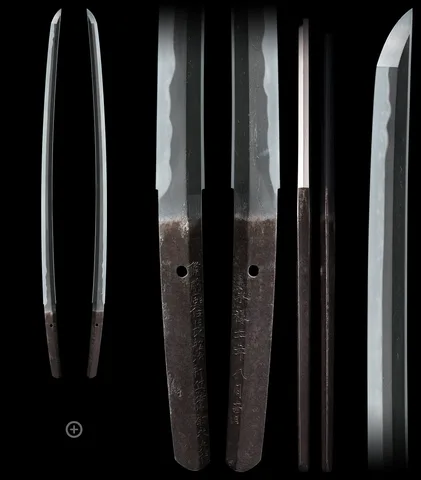
Sue-Bizen katana signed by Jirōbyōe-no-jō Nagamitsu of Osafune and dated to the 8th month of Eiroku 4 (1561), with an intact nakago, a declared Tokubetsu Hozon paper and a complete koshirae. Katana from the Osafune school of Bizen, the work of Nagamitsu (永光), Jirōbyōe-no-jō, one of the Sue-Bizen smiths of the Eiroku era. The blade has a nagasa of 70.0 cm and a sori of 1.5 cm; according to the original seller it is of shinogi-zukuri construction with iori-mune, an itame hada with tightly packed ko-itame and utsuri rising towards the shinogi, and a broad suguha hamon in ko-nie with koshiba, ashi and nioi-kuzure; the bōshi is of the same character, with hakikake and a short kaeri. The photographs show the whole blade, the elongated kissaki and the nakago, with a single mekugi-ana, katte-sagari yasurime and kurijiri, apparently intact. Long signature on the omote, “Bizen no kuni jū Osafune Jirōbyōe-no-jō Nagamitsu saku”, and date on the ura, “Eiroku 4 nen 8 gatsu kichijitsu” (1561). The seller states an NBTHK Tokubetsu Hozon paper, which does not appear in the photographs. It comes with a complete koshirae: black-lacquered saya with sageo, tsuka with same and brown silk wrap, dark fuchi-kashira with gold flowers and an iron tsuba pierced with circular and floral motifs; the seller includes it without describing or dating it.
62.3/100
€24,390