Osafune Sukesada
長船祐定 (Osafune Sukesada)
Lineage: the signature does not state the generation
Name borne by a long line of Osafune smiths in Bizen, active mainly in the 16th century and continued into the Edo period.
Profile
Sukesada (祐定) is the most common name in Sue-Bizen (末備前), the last phase of the Osafune school: some forty different smiths are recorded under it. The known ones begin around the Eishō era (1504-1521) with Hikobei-no-jō (彦兵衛尉) and his son Yosōzaemon-no-jō (与三左衛門尉), the most highly regarded of the line, followed by Genbei-no-jō (源兵衛尉). The workshop produced in quantity, and relatives and pupils worked under the same name. Commissioned blades usually add the smith's personal name and a date; production work reads only Bishū Osafune Sukesada (備州長船祐定). Short uchigatana are frequent, with a gunome-midare hamon broad at the base, sometimes ending in crab-claw heads, and more nie than in earlier Bizen work. After the Yoshii river flood in the late 16th century, the Yokoyama family carried the name on in Osafune through the Edo period; its leading figure was Yokoyama Kōzuke Daijō Sukesada (横山上野大掾祐定), in the second half of the 17th century. Works of the line are held in public collections in Japan.
Swords available
-
Sukesada
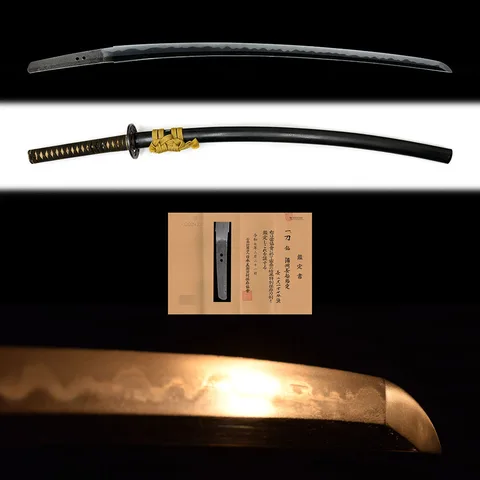
Katana signed Bishū Osafune Sukesada, mid to late Muromachi, with NBTHK Tokubetsu Hozon Tōken, an uchigatana-koshirae with black ishime saya, and shirasaya. Katana by Bishū Osafune Sukesada, a line of smiths that, together with Katsumitsu and Kiyomitsu, represents the Osafune school of Bizen at the end of the Muromachi period; the original seller places it between the mid and late Muromachi. The blade has a nagasa of 65.85 cm and a sori of 2.1 cm, with a saki-zori profile and a clear taper from base to point. According to the original seller, the jigane is well-forged mokume, slightly hadatachi with chikei; the hamon is notare with gunome, ashi, sunagashi and ko-chōji, and the bōshi runs into midare with a rounded return; the blade is declared healthy, with no notable forging flaws. The nakago, which appears ubu in the photographs, with two mekugi-ana and a kurijiri end, bears the signature "Bishū Osafune Sukesada" without a personal name. It comes with an NBTHK Tokubetsu Hozon Tōken certificate dated February 2025, legible in the photographs. The mounting is an uchigatana-koshirae with a black ishime-lacquered saya, an openwork iron tsuba with pine and hut, shakudō fuchi-kashira with gold chrysanthemums, a same-covered tsuka with dark wrap and a gold sageo; the seller describes it as in good condition, with slight play in the tsuka, and does not date it. Two-piece shakudō habaki and shirasaya with tsunagi.
52.7/100
€18,020
-
Sukesada
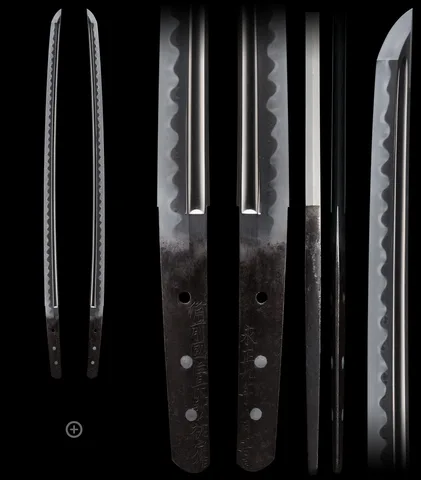
Kotō katana by Osafune Sukesada, signed and dated Eishō 9 (1512), with an intact tang, a complete koshirae and a declared Tokubetsu Hozon certificate. Katana signed Bizen no kuni jū Osafune Sukesada saku and dated to the eighth month of Eishō 9 (1512), a work of the Osafune school of Bizen at the height of the Sengoku period. The blade measures 61.2 cm in nagasa with a sori of 0.9 cm, honzukuri construction, a gentle curve, slight tapering towards the point and a somewhat extended kissaki. The original seller describes a tightly packed itame with chikei and midare-utsuri rising from the base, a nioi-based koshi-hiraki midare hamon with ashi and round spots of temper between the waves, and a midare-komi bōshi with ko-maru and a short return. It carries a bō-hi with soe-hi in katachiri style, ending in kaku-dome below the machi. The tang, with kurijiri and lightly cut katte-sagari file marks, appears intact in the photographs, with three mekugi-ana, two of them plugged. It comes with a koshirae featuring a black lacquered saya, a tsuka with same and a light-toned, worn wrap, an iron tsuba with lattice openwork, dark-metal fuchi-kashira with relief motifs, decorated kozuka and kōgai and a blue-and-gold sageo; the seller neither describes nor dates it. NBTHK Tokubetsu Hozon Tōken certificate declared by the seller, not visible in the photographs; a shirasaya is also declared.
48.8/100
€30,410