Sesshū Kunimitsu
摂州国光 (Sesshū Kunimitsu)
Osaka swordsmith of Settsu province, from the family of Kawachi no Kami Kunisuke, active around the middle of the 17th century.
Profile
Sesshū Kunimitsu is the name under which period lists record a smith of Osaka, in Settsu province, from the early shintō era. School tradition identifies him with the early name of Musashi no Kami Kunitsugu (武蔵守国次, Musashi no Kami Kunitsugu), second son of the first Kawachi no Kami Kunisuke (河内守国助, Kawachi no Kami Kunisuke), one of the founders of Osaka shintō, and younger brother of the second Kunisuke, known as Naka Kawachi (中河内, Naka Kawachi). According to that tradition he first signed Kunimitsu or Sesshū-jū Kunimitsu, and later Musashi Daijō Kunitsugu and Musashi no Kami Kunitsugu. He spent much of his working life in the family workshop alongside his brother, which is why blades under his own name are scarce; at least one blade signed jointly with his brother is attributed to him. His work follows the workshop manner: well-forged blades with hamon ranging from suguha to gunome and chōji midare.
Rankings
- Wazamono (good) (Kaihō Kenjaku, 1797)
Swords available
-
Kunimitsu
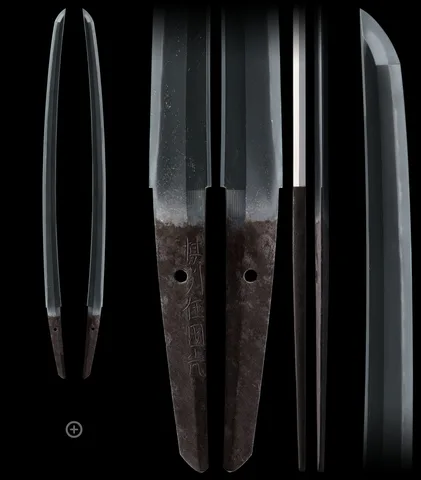
Shintō katana from Settsu signed Sesshū-jū Kunimitsu, of the Kunisuke school of Osaka, with a suguha in nioi, a restrained mounting and a Tokubetsu Hozon certificate according to the original seller. Katana signed Sesshū-jū Kunimitsu, a shintō work from Settsu (Osaka) that the original seller places in the early Edo period, in the Kanbun era, and assigns to the school of Kawachi no Kami Kunisuke, the house that founded Osaka shintō; according to the listing, the signature would belong to the early period of Musashi no Kami Kunitsugu, son of the first Kunisuke. The blade has a nagasa of 61.2 cm and a sori of 1.6 cm, in shinogi-zukuri with deep curvature, a profile tapering to a chū-kissaki and a nakago that is short in proportion, in the katate-uchi style of the Sengoku period. The seller describes a tight ko-itame hada with itame and masame near the mune, and a fairly wide suguha hamon in nioi with ko-nie, ashi and nioi-kuzure features; the bōshi is straight with a deep ko-maru return. The photographs show the tang with a single mekugi-ana, katte-sagari yasurime and kurijiri, with the full signature on the omote. It comes with a mounting of restrained taste: black-lacquered saya, tsuka with same and ochre wrap, dark-metal fuchi-kashira with gilt figures, menuki and an openwork iron tsuba; the seller neither dates it nor describes its fittings. It holds an NBTHK Tokubetsu Hozon Tōken certificate, according to the seller, and comes with a shirasaya.
52.9/100
€6,610