Tachibana Kunihide
橘国秀 (Tachibana Kunihide)
Lineage: the signature does not state the generation
Swordsmith of Annaka in Kōzuke, retained by the Itakura clan from the Tenpō era; he later worked in Kamakura, Sagami province.
Profile
Kunihide, whose personal name was Tachibana Hayato (橘隼人), worked in Kōzuke province from the Tenpō era (1830-1844) onwards. A pupil of Ikkansai Yoshihiro (一貫斎義弘), he served as swordsmith to the Itakura clan, lords of the Annaka domain. He used the art name Enryūshi (圓龍子) and wrote his family name either as 橘 (Tachibana) or 立花 (Tachibana). Among his signatures are Jōshū Annaka-jū Enryūshi Tachibana Kunihide and Tachibana Enryūshi Kunihide saku, and on a blade dated 1843 he styles himself a distant heir of Masamune with the phrase Sōshū Masamune matsuyō (相州正宗末葉). Later, somewhere between the Kaei and Bunkyū eras, he settled in Kamakura and signed as a resident of that Sagami town. His blades tend to have a wide mihaba and an extended kissaki, an ō-itame or masame hada and a notare hamon mixed with gunome and sunagashi, following the Sōshū manner. He is counted as the teacher of Yoshihide (義秀), who also signed with the name Tachibana Enryūshi.
Swords available
-
Tachibana Enryūshi Fujiwara Kunihide
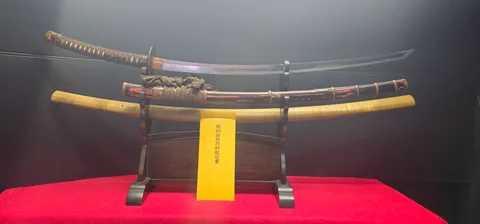
Shinshintō katana of 80.6 cm, signed and dated Tenpō 14 (1843) by Tachibana Enryūshi Kunihide, with a long votive inscription, Tokubetsu Hozon paper, koshirae and shirasaya. A blade by Tachibana Enryūshi Fujiwara Kunihide, who describes himself in his signature as a descendant of the Sōshū Masamune line. Dated to the second month of Tenpō 14 (1843), it belongs to the shinshintō period. The tang carries a long inscription on both faces: besides the signature and date, an oath sworn before the gods and a dedication to Koitabashi Fujiwara Masayasu of Annaka castle in Kōzuke. According to the original seller, the blade commemorates the smith reaching the full maturity of his craft. It measures 80.6 cm in nagasa with 1.6 cm of sori, 3.36 cm motohaba and 1.17 cm kasane, and weighs 1385 g without mounts: a broad, robust shape. The original seller describes a tightly packed ko-itame and a suguha hamon mixed with gunome midare, rich in sunagashi and kinsuji. The photographs show an intact tang with a single mekugi-ana. It comes with a koshirae with an iron tsuba, a tsuka wrapped in brown ito over white same, and a black lacquered saya with reddish highlights and metal bands, as well as a shirasaya. NBTHK Tokubetsu Hozon Tōken paper issued in 2019.
58.6/100
€19,150