Tegai Kanekiyo
手掻包清 (Tegai Kanekiyo)
Lineage: the signature does not state the generation
A name of the Tegai school of Nara, in Yamato, carried by several smiths from the end of the Kamakura period into the Muromachi period.
Profile
Kanekiyo is a name of the Tegai school, the Nara workshop that stood before the Tengai gate (転害門, Tengaimon) of Tōdai-ji and was attached to that temple. Several smiths bore it in succession, from the late Kamakura or Nanbokuchō period well into the Muromachi period; school tradition holds that the first was a son of the founder, Kanenaga (包永), and like others of the line he took the character kane (包) from the founder's name. Those working in the Muromachi period are counted among the Sue-Tegai (末手掻), the later branch of the school. The signature does not tell which generation made a blade, and much of what survives has been shortened and is unsigned, so the work is known largely through attribution. It follows the Yamato manner: a shinogi-zukuri shape with a high shinogi, a ko-itame hada mixed with masame and covered in clear nie, and a nie-based suguha hamon with hotsure, uchinoke and nijūba, running into a bōshi that is yakizume or strongly worked in nie.
Swords available
-
Kanekiyo
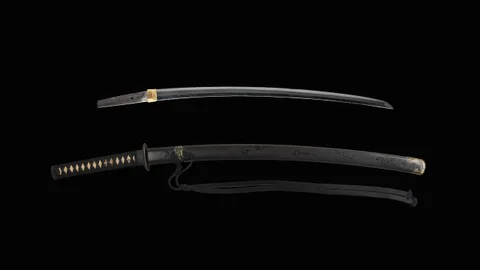
Katana signed Kanekiyo, a smith of the Tegai school, the largest of the five Yamato traditions, which grew up by the Tegai gate of the Tōdai-ji and flourished through the Nanbokuchō and Muromachi periods. According to the original seller, several generations used the name between the 14th and 16th centuries, and this signature belongs to the Kanekiyo working in the early 15th century. The blade has a nagasa of 62.2 cm and a sori of 2 cm, with a motohaba of 3.02 cm and a sakihaba of 1.84 cm; the seller describes an itame jihada with mokume and a suguha hamon mixed with gunome, ashi and konie. The photographs show a tang with a single mekugi-ana, continuous file marks and a rounded tip, with the two-character signature chiselled near the machi. It comes with an uchigatana koshirae whose black ishime-lacquered saya carries makie decoration, dated by the seller to the late Edo period: an iron tsuba with a dragon among clouds, gilt menuki, nanako fuchi-kashira and an iron kojiri with gold tendrils and leaves. The seller states an NBTHK Tokubetsu Hozon certificate.
52.9/100
€15,950