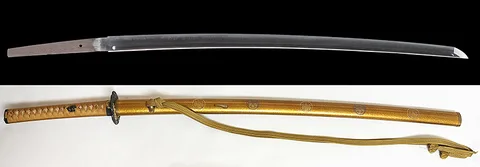
Tsushima no Kami Tsunemitsu
対馬守常光 (Tsushima no Kami Tsunemitsu)
Swordsmith of the Edo Ishidō school in Musashi, active from the mid-17th century, who worked chōji hamon in the manner of Bizen Ichimonji.
Profile
Tsunemitsu, who held the title Tsushima no Kami (対馬守), was one of the leading smiths of the Edo branch of the Ishidō (石堂) school, the group that in the Shintō period took up again the chōji-midare of the Kamakura-period Bizen Ichimonji. His family came from Ōmi, and school tradition makes him the younger brother of Heki Mitsuhira (日置光平), the other prominent name of the Edo Ishidō. He worked in Edo, in Musashi province, from the Keian era (1648-1652) through the second half of the 17th century; a blade of his dated 1681 is recorded. He signed Tsushima no Kami Tachibana Tsunemitsu (対馬守橘常光), sometimes preceded by Bushū jū (武州住) and later with nyūdō (入道) added. Over an itame jigane he hardened a tightly packed chōji, with smaller elements and less rise and fall than Mitsuhira's. Some authors identify him with Tachibana Ippō (橘一法), a name he would have used in old age; others treat Ippō as a separate smith.
Rankings
- Yoki-wazamono (very good) (Kaihō Kenjaku, 1797)
Swords available
-
Tsushima no Kami Tsunemitsu
Jūyō Tōken katana by Tsushima no Kami Tsunemitsu of the Edo Ishidō school, signed and dated Kanbun 1 (1661), with ubu tang, gold nashiji lacquer koshirae bearing family crests, and shirasaya. Katana by Tsushima no Kami Tsunemitsu, one of the masters of the Edo Ishidō school, the shintō line that revived the chōji-midare of the old Ichimonji smiths. According to the original seller, Tsunemitsu, of the Heki family, came from Ōmi and worked in Edo alongside Mitsuhira and Munehiro. The blade, with a nagasa of 74.2 cm and a sori of 1.4 cm, shows a chōji-midare hamon mixed with jūka-chōji and gunome, with abundant ashi and yō, typical of the smith. The tang is ubu, with kurijiri and a single mekugi-ana; it bears the signature “Tsushima no Kami Tachibana Tsunemitsu” on the omote and the date “a day in the eighth month of Kanbun 1” (1661) on the ura. The blade was designated Jūyō Tōken by the NBTHK at the 22nd session (June 1974); the photographs show the certificate, the zufu page and the oshigata. It comes with a koshirae featuring a gold nashiji lacquer saya decorated with family crests (mon), a tsuka wrapped in gold silk over same, a dark tsuba with bamboo in gold relief and a matching sageo, together with a shirasaya. The original seller neither describes nor dates the mounting.
62.3/100
€55,690