Aoki Kiyohide
青木清秀 (Aoki Kiyohide)
Lineage: the signature does not state the generation
Swordsmith of Kurume in Chikugo province, active in the first half of the 19th century, at the end of the Edo period.
Profile
Aoki Kiyohide worked in Kurume, in Chikugo province (the south of present-day Fukuoka), during the final phase of the Edo period. The cultural properties database of the Agency for Cultural Affairs credits him with works dated between 1807 and 1849, a span that the signature alone does not allow to be divided between one or more generations. Local tradition holds that he worked in the service of the Kurume domain, ruled by the Arima house. His common name was Seibei (清兵衛), and among other forms he signed Kurume jū Aoki Seibei Kiyohide (久留米住青木清兵衛清秀); in the 1840s the honorary title Ōmi no Suke (近江介) appears in his signatures, as in Chikugo no kuni Aoki Ōmi no Suke Minamoto Kiyohide (筑後国青木近江介源清秀). He is credited with gunome midare and chōji midare hamon with a tight nioiguchi, in the Bizen manner, as well as suguha. The Tokyo National Museum holds an iron bow (tekkyū, 鉄弓) bearing his signature, an unusual piece that can be flexed and strung like a bow of bamboo or wood.
Swords available
-
Chikugo Aoki Ōmi no Suke Minamoto Kiyohide
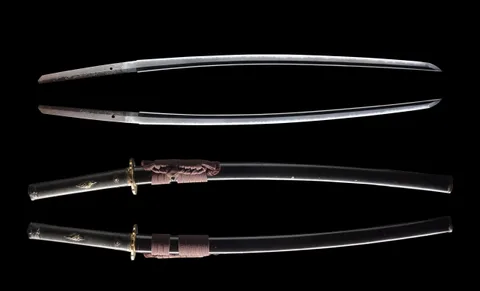
Shinshintō katana signed and dated 1847 by Kiyohide, a smith in the service of the Arima clan in Chikugo. It retains a koshirae with black lacquer saya, mokkō tsuba with gold kiri-mon, and an NBTHK Tokubetsu Hozon origami. Shinshintō katana by Chikugo no Kuni Aoki Ōmi no Suke Minamoto Kiyohide, a smith of Chikugo province who, according to the original seller, served the Arima clan of the Kurume domain and received the court title of Ōmi no Suke in 1845; his work is associated with the Bizen tradition and its chōji midare hamon. The blade measures 63.6 cm nagasa and 1.7 cm sori, and the photographs show a clean polish, a well-defined undulating temper line and an intact bōshi. The tang is ubu with a single mekugi-ana, signed 筑後国青木近江介源清秀 (Chikugo no Kuni Aoki Ōmi no Suke Minamoto Kiyohide) on the omote and dated 弘化四年二月日 (Kōka yonen nigatsu hi) on the ura. The koshirae, described but not dated by the original seller, comprises a black roiro lacquer saya, a lacquered-cord tsuka with menuki of a mounted warrior, kikusui fuchi-kashira and a mokkō tsuba with gold kiri-mon; the sageo is a replacement. An NBTHK Tokubetsu Hozon Tōken origami, legible in the photographs, and a shirasaya accompany the sword.
69.8/100
€10,700