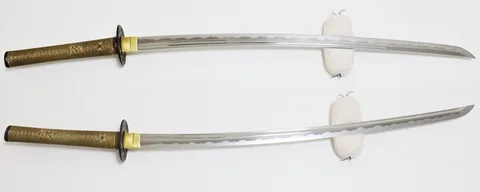
Chikanori
近則 (Chikanori)
Lineage: the signature does not state the generation
Swordsmith of Mito in Hitachi, of the Kawamura family and a pupil of Taikei Naotane, active in the mid-19th century.
Profile
Chikanori (近則) worked in Mito, Hitachi province, in the middle of the 19th century. He was adopted by Kawamura Kanzaburō (川村勘三郎), fifth head of the house counted from Bokuden (卜伝); this family of smiths had settled in Mito in the 17th century and traced its descent to Zenjō Kaneyoshi (善定兼吉) of Seki. On his adoption he took the Kawamura surname and the smith name Chikanori. Tradition gives his birth name as Kikuchi Toyosaburō (菊池豊三郎). In the autumn of 1839, when Taikei Naotane (大慶直胤) was staying at Sukegawa Castle in the Mito fief, Chikanori entered his school; it is said that the fief then sent him to train for a year at Naotane's workshop in Edo, and that on his return he served as a fief smith. Among other forms he signed Mito jū Fujiwara Chikanori (水戸住藤原近則) and Seki Zenjō-ke Chikanori saku (関善定家近則作), the latter recalling the family's origins.
Swords available
-
Sekizenjō Chikanori
Katana by Sekizenjō Chikanori, Mito domain smith and pupil of Naotane, signed and dated 1869, ubu, with an aogai-lacquered koshirae made for the blade according to the seller and NBTHK Tokubetsu Hozon paper. Katana by Sekizenjō Chikanori (関善定家近則), a Mito smith of the late shinshintō period. According to the seller of origin, born in 1815, he trained under Taikei Naotane, served the Mito domain as smith and inherited the Seki Zenjō line by adoption. The blade, shinogi-zukuri with iori-mune and a nagasa of 71.3 cm, is signed and dated the 8th month of Meiji 2 (1869), made to order for the Ebata family. The seller describes a tight ko-itame with ji-nie, a gunome-midare in ko-nie with ashi, and a midare bōshi with ko-maru turnback; it carries two futasuji-hi on the omote and a bō-hi with soe-hi on the ura. The nakago is ubu, with keshō sujikai yasurime, kurijiri and a single mekugi-ana, as the photographs confirm. Included are a gold-foiled copper habaki, a shirasaya and an uchigatana-koshirae with aogai mijin-nuri lacquered saya (98.7 cm) which, the seller states, was made for this blade: an iron tsuba with inlaid dragon, clouds and waves, tiger menuki in gold iroe, ‘horse from a gourd’ fuchi-kashira, white same with hemp ito and an iron kojiri. The tsuba holds a Tokubetsu Kichō Kodōgu certificate of 1970, from the now retired system. NBTHK Tokubetsu Hozon Tōken paper of 2012; published in several catalogues of Mito swords.
76.6/100
€16,020