On this page
The Honsaku Chōgi
- 本作長義 (Honsaku Chōgi) is a heavily shortened katana, without its original signature, at the Tokugawa Art Museum, in Nagoya.
- Hōjō Ujinao gave it to Nagao Akinaga on 21 July 1586; on 3 May 1590 Horikawa Kunihiro engraved a 62-character inscription on the tang; Tokugawa Tsunanari bought it in 1681. It has an appraisal certificate (折紙, origami) by Hon'ami Kōjō.
- It became an Important Art Object in 1939 and has been an Important Cultural Property since 29 August 1950, the date on the State record. The Japanese Wikipedia gives another date, 18 February 1949.
- It is the model for Kunihiro’s copy, the 山姥切国広 (Yamanbagiri Kunihiro), an Important Cultural Property since 1962; according to the Japanese Wikipedia, it is the only case of an original and a copy that are both designated.
His designated works and those in museums
| Work | Designation | Where it is |
|---|---|---|
| 本作長義 (Honsaku Chōgi), katana | Important Cultural Property (1949 or 1950) | Tokugawa Art Museum, Nagoya |
| 大坂長義 (Ōsaka Chōgi), tantō dated 1360 | Important Cultural Property | — |
| 朱銘長義 (Shu-mei Chōgi), wakizashi | Important Cultural Property | Myōkokuji temple, on deposit at the Sakai Museum |
| Tachi 銘備州長船住長義 (mei Bishū Osafune jū Chōgi) | Important Cultural Property | The company Brest Sieve, according to the Japanese Wikipedia |
| Tachi 銘備前国長船住長義 (mei Bizen no Kuni Osafune jū Chōgi) | Important Cultural Property | Kanisendō foundation; stolen in 1991, according to the Japanese Wikipedia |
| Katana with the gold inscription 長義磨上 (Chōgi suriage) by Hon'ami Kōshitsu, 71.5 cm | Important Art Object | Tsuchiura City Museum |
| 六股長義 (Rokumata Chōgi) | Important Art Object | Burned in the Second World War |
| Tachi 銘備前国長船住長義 (mei Bizen no Kuni Osafune jū Chōgi) | Not listed in ColBase | Tokyo National Museum |
| Tantō 銘備州長船住長義 (mei Bishū Osafune jū Chōgi), Shōhei 17 (1362), 27.6 cm | Not listed in ColBase | Tokyo National Museum |
| Katana 朱銘長義 (shu-mei Chōgi), 66.8 cm | Not listed in ColBase | Kyūshū National Museum |
The NBTHK speaks of two signed tachi that are Important Cultural Properties, one at the Tokyo National Museum, dated Kōryaku 1 (1379), and of an uchigatana with the same date. The Japanese Wikipedia gives a different whereabouts for the two tachi; it has not been possible to reconcile them.
The Kyūshū National Museum describes its katana with ō-kissaki, ō-itame with nie, notare with gunome, a pointed bōshi and bōhi, and allows that it could be of the Ōmiya school.
His only signed naginata
A signed naginata, now turned into a tachi (naginata-naoshi) of 75.1 cm, is Tokubetsu Jūyō of the NBTHK: itame with ji-nie and chikei, ko-notare with a complex midare and a very large kissaki. It was shown in “Masamune Jūtetsu”, at the Japanese Sword Museum, in January and February 2024.
In the lists
- The 六股長義 (Rokumata Chōgi), of the Ōkubo of Odawara, and the Honsaku Chōgi were his most cited works; the first burned in the war. Of the 八文字長義 (Hachimonji Chōgi), in a private collection, only the Japanese Wikipedia gives any report.
- His article in the Japanese Wikipedia says that the Kokon Kaji Bikō classes him as ō-wazamono, but the wazamono list of the same Wikipedia does not include him.
At the Kyūshū National Museum
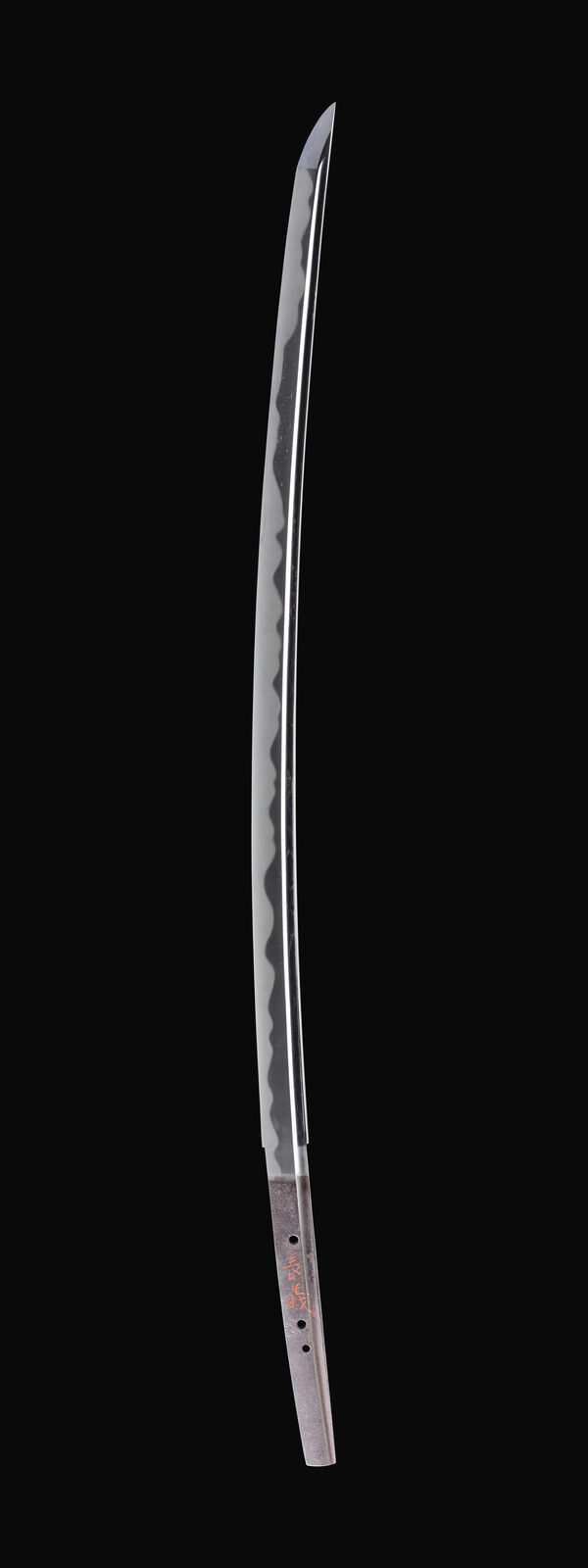
Katana with the red-lacquer attribution 朱銘長義 (shu-mei Chōgi), whole. Kyūshū National Museum, via ColBase · ColBase terms of use · source 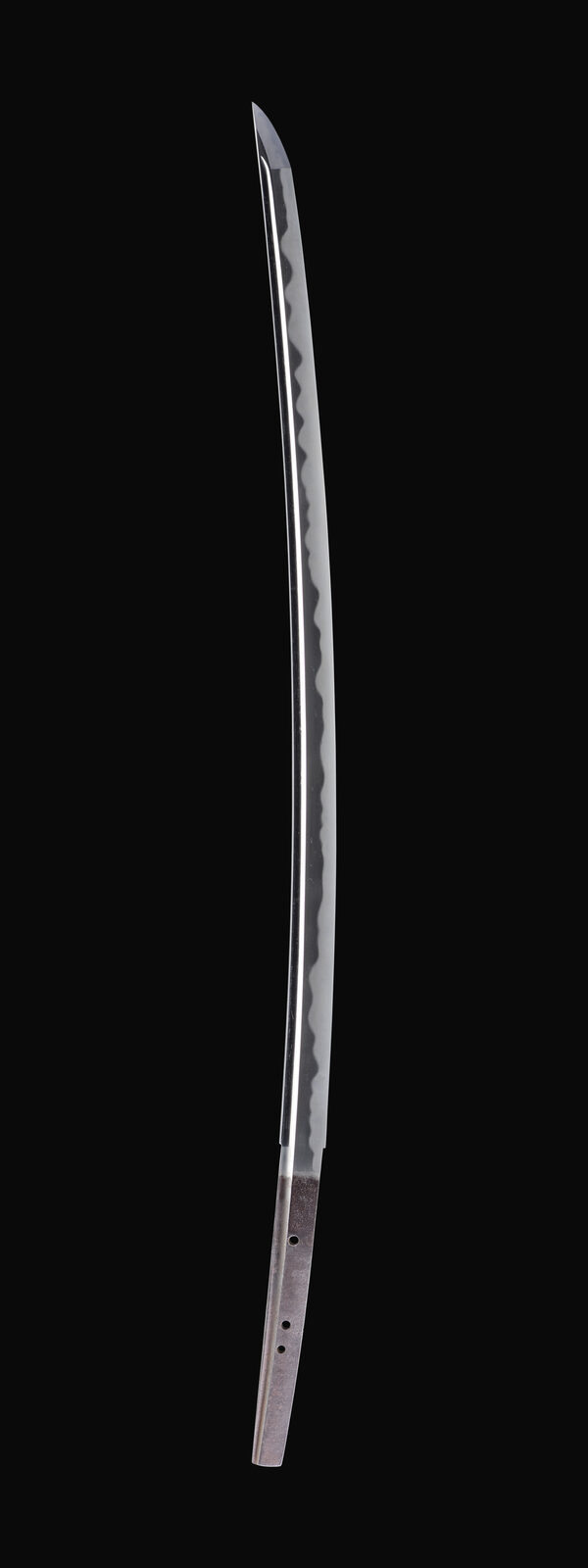
The same katana, from the other face. Kyūshū National Museum, via ColBase · ColBase terms of use · source 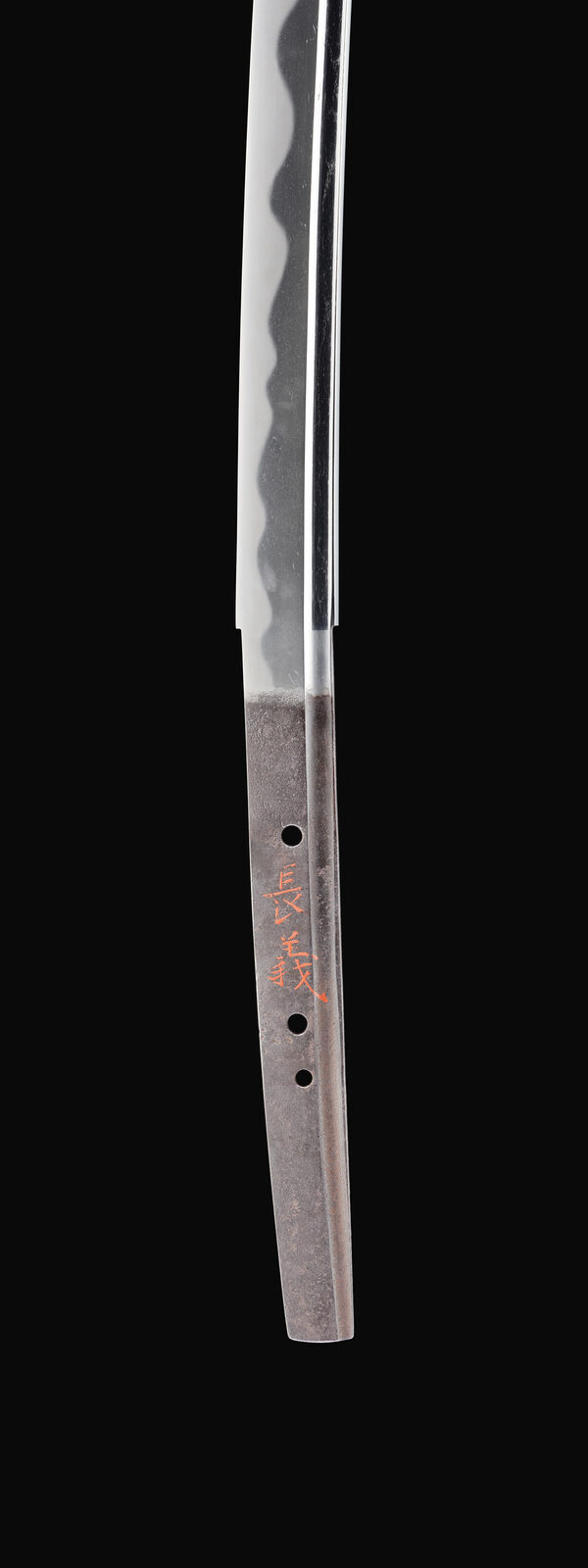
The same katana: the lower half, with the shortened tang. Kyūshū National Museum, via ColBase · ColBase terms of use · source