On this page
The family
- The Gamagōri museum presents father and son as tool smiths (野鍛冶, nokaji) of Takeya who ended up forging swords.
- His father, 藤原武則 (Fujiwara Takenori), was born in 1911. In 1940 he won a silver medal at the Ministry of Education’s exhibition of new swords and the following year the gold, with which he went on to forge on commission for the Army arsenal. After the war he was selected seven times at the NBTHK Shinsaku Meitōten. He died in 1973.
- The family line goes back, through two generations of Fujiwara Kazunori, to 石堂是一 (Ishidō Korekazu), whose school sought to revive the Bizen tradition in the shintō period; that tradition passed to Mikawa and lasted until the Shōwa era.
His forge
- Fujiwara Motohisa was born in 1934 and from 1950 learned under his father.
- He received his swordsmith’s licence from the Agency for Cultural Affairs in November 1967. He was a member of the NBTHK and of the all-Japan swordsmiths’ association, and was selected twenty-seven times at the Shinsaku Meitōten.
- Many iaidō practitioners used his swords, which the museum describes as sober and sturdy. The founder of Nakamura-ryū battōdō, 中村泰三郎 (Nakamura Taizaburō), preferred them.
- He died in 2008.
The 2023 exhibition
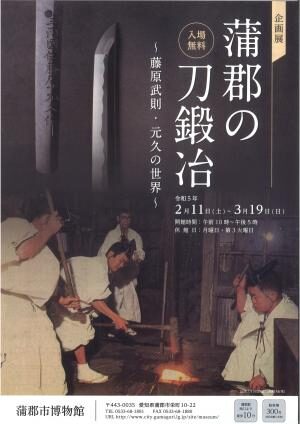
From 11 February to 19 March 2023, the Gamagōri museum held “蒲郡の刀鍛冶〜藤原武則・元久の世界〜” (Gamagōri no katanakaji Fujiwara Takenori Motohisa no sekai, “The swordsmiths of Gamagōri: the world of Fujiwara Takenori and Motohisa”), with twenty-five swords and ninety pieces in all. On 12 February, the Mikawa branch of the 戸山流 (Toyama-ryū) gave an iaidō demonstration with his swords. In the television report, his son 橋本共嗣 (Hashimoto Tomotsugu) explained how his style changed over the years.