On this page
Style
- He forged in several traditions: the midare of Bizen (備前伝, Bizen-den), the masame of Yamato (大和伝, Yamato-den) and the suguha of Hizen. His blades cut well and are often long, from 71 to 76 cm.
- A katana of 1987, signed 三河國住藤原元久作 (Mikawa no kuni jū Fujiwara Motohisa saku), has a hamon of wide gunome with chōji, thick ashi and much sunagashi; a straight bōshi with a round turn-back, and an unshortened tang, with ōsujikai file marks and a kurijiri tip.
The katana for Nakamura Taizaburō
A katana of June 1991 bears on one face of the tang 三河國住藤原元久作 (Mikawa no kuni jū Fujiwara Motohisa saku) and 平成三年六月吉日 (Heisei sannen rokugatsu kichijitsu, “an auspicious day in June 1991”); on the other, 剣魂 (kenkon, “the soul of the sword”), 中村流抜刀道八方斬 (Nakamura-ryū battōdō happōgiri, “the eight-direction cut of Nakamura-ryū battōdō”) and 応需宗家中村泰三郎氏 (ōju sōke Nakamura Taizaburō-shi, “at the request of the head of the school, Mr Nakamura Taizaburō”). 中村泰三郎 (Nakamura Taizaburō, 1912-2003) founded Nakamura-ryū battōdō.
Gallery
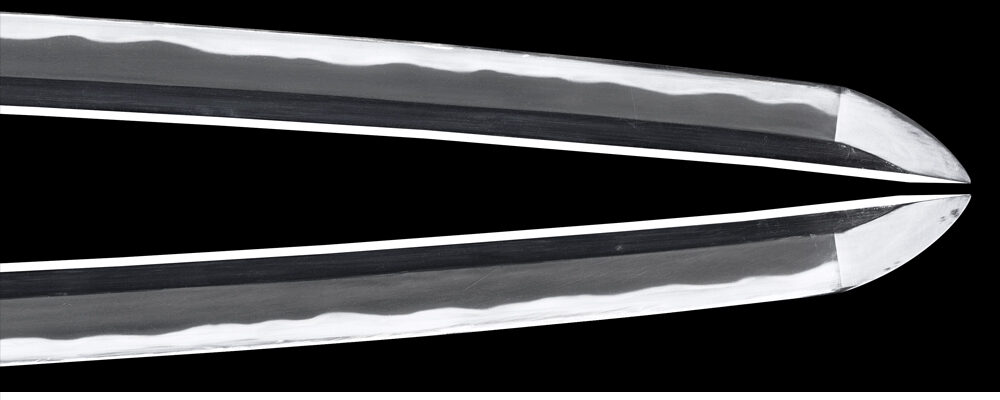
The point of the 1991 katana for Nakamura Taizaburō. Photo: dealer in Japan 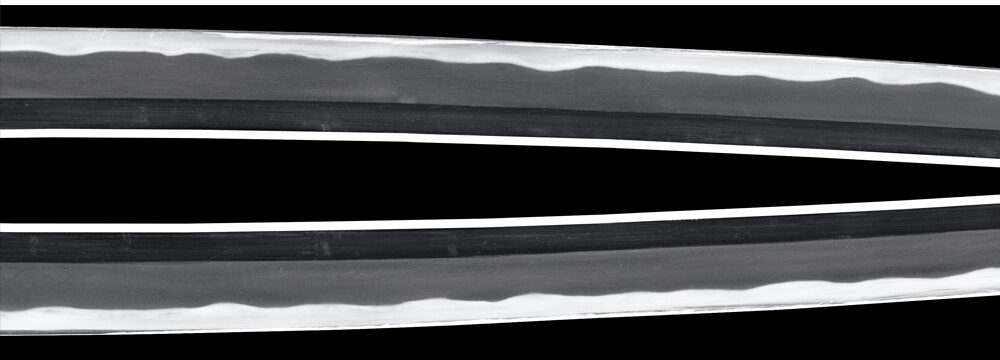
The hamon of the same katana, in gentle waves. Photo: dealer in Japan 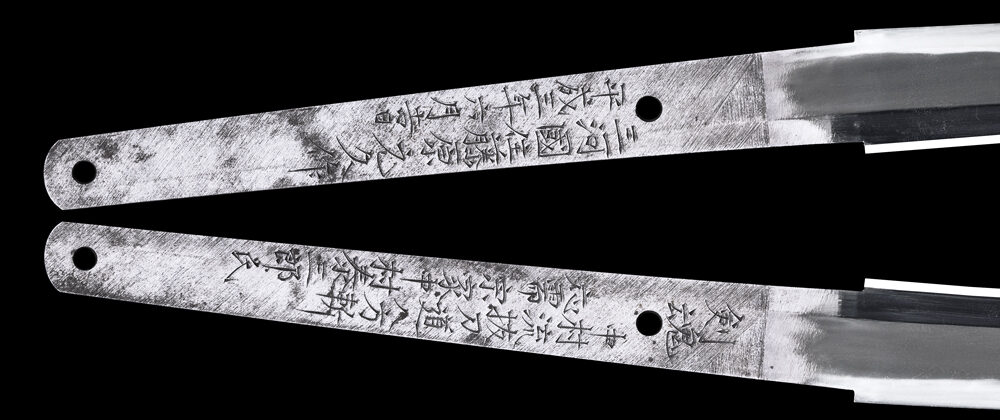
Its tang, with the signature, the date and the dedication to Nakamura Taizaburō. Photo: dealer in Japan