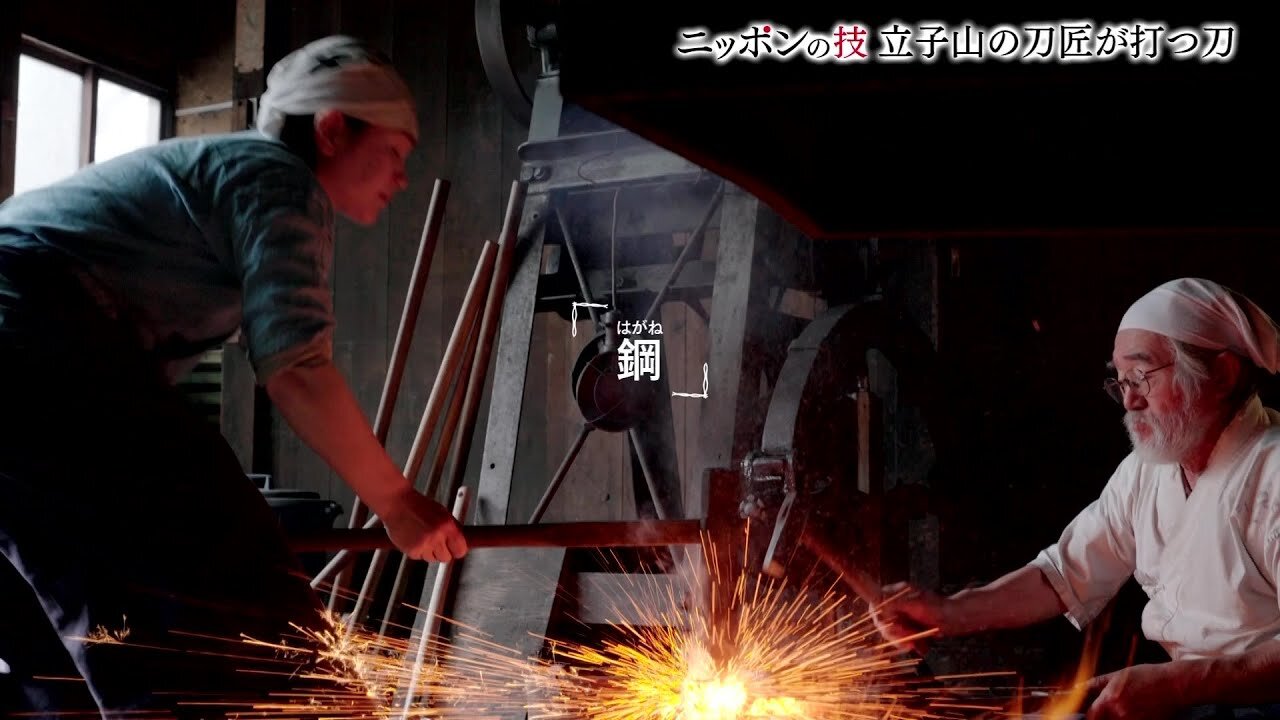
Two swordsmiths work a red-hot piece amid sparks in a wooden forge; on the right, an elderly man with a white beard.

Still from the video, © TUFchannel · © TUFchannel

From Kawamata to Tatsugoyama

Life and forging

A book by his future master made him decide to become a swordsmith. Since then, sixty years of forging in Fukushima, offering forgings at the great shrines and an iron furnace of his own.

On this page
  1. Offering forgings
  2. On television
  3. Family

The sword

History

  1. The sword

    Born in Kawamata AT

    He is born in Kawamata (Date, Fukushima) and at the age of five moves to the city of Fukushima.

  2. The sword

    Pupil of Miyairi Akihira AT

    At the Fukushima industrial school he reads 『刀匠一代』 (Tōshō ichidai), Miyairi Akihira’s book, and decides to become a swordsmith. On 17 February 1966 he becomes his pupil.

  3. The sword

    Licence AT

    He receives his swordsmith’s licence from the Agency for Cultural Affairs, and his first tachi wins the effort prize at the 8th new-work competition.

  4. The sword

    His forge in Tatsugoyama AT

    He sets up on his own and opens his forge in Tatsugoyama (立子山), in Fukushima.

  5. The sword

    With Takayama Takeshi AT

    He joins the study group of the researcher Takayama Takeshi (髙山武士), and in 1988 founds a group of swordsmiths.

  6. The sword

    A sword for Ise AT

    Prize of the president of the NBTHK; he is commissioned to make a sacred sword for the periodic transfer of the Ise shrine.

  7. The sword

    Meteorite iron AT

    He forges the 隕星剣 (Inseiken) from meteoric iron for the Hoshi-no-mura observatory, in Tamura (Fukushima).

  8. The sword

    The iron furnace AT

    With Yoshida Hidetaka, of the Mahoron centre in Fukushima, he begins his iron-smelting experiments; since 2012 he has built the “Tatsugoyama furnace” every year.

  9. The sword

    An ōdachi of 2.16 m AT

    With his pupils he forges an ōdachi of 2.16 m and 2.8 kg.

  10. History

    A book about him AT

    『ふくしま手語り 孤高の鎚音』 (Fukushima tegatari: Kokō no tsuchioto) is published, written with the photographer Akanuma Hiroshi.

Offering forgings

He has done public offering forgings in Nara, at the Gotoh Museum in Tokyo, at the Yasukuni shrine and at the Atsuta Jingū (熱田神宮), and in 2006 at the Kashima Jingū (鹿島神宮), where no forging had been done for eight hundred years.

On television

In 2009 a sword of his cut iron pipes on a Fuji TV programme, at the request of an iaidō practitioner. He has appeared on 「日曜美術館」 (Nichiyō Bijutsukan, NHK, 2014), on BS Asahi (2019) and in a report by TUF, the Fukushima television station (2025).

Family

His father, Fujiyasu Yūshirō, opened the first invisible-mending workshop (かけはぎ, kakehagi) in Fukushima. The sources disagree about his son Ken'ichirō: the Japanese Wikipedia gives him as the eldest, and another source as the second.