On this page
Style
He mastered the 綾杉肌 (ayasugi-hada), the regular, wavy grain typical of the Gassan, but also the Bizen and Sōshū traditions. Many early works revive shapes of the Heian and Kamakura periods: slender blades with a small kissaki and carvings of great quality.
As a carver (彫物師, horimonoshi) he preferred plum branches and the verses of 本居宣長 (Motoori Norinaga), according to the German Wikipedia. The nakago of the Gassan are finished with characteristic file marks, and his signature is recognisable by its care.
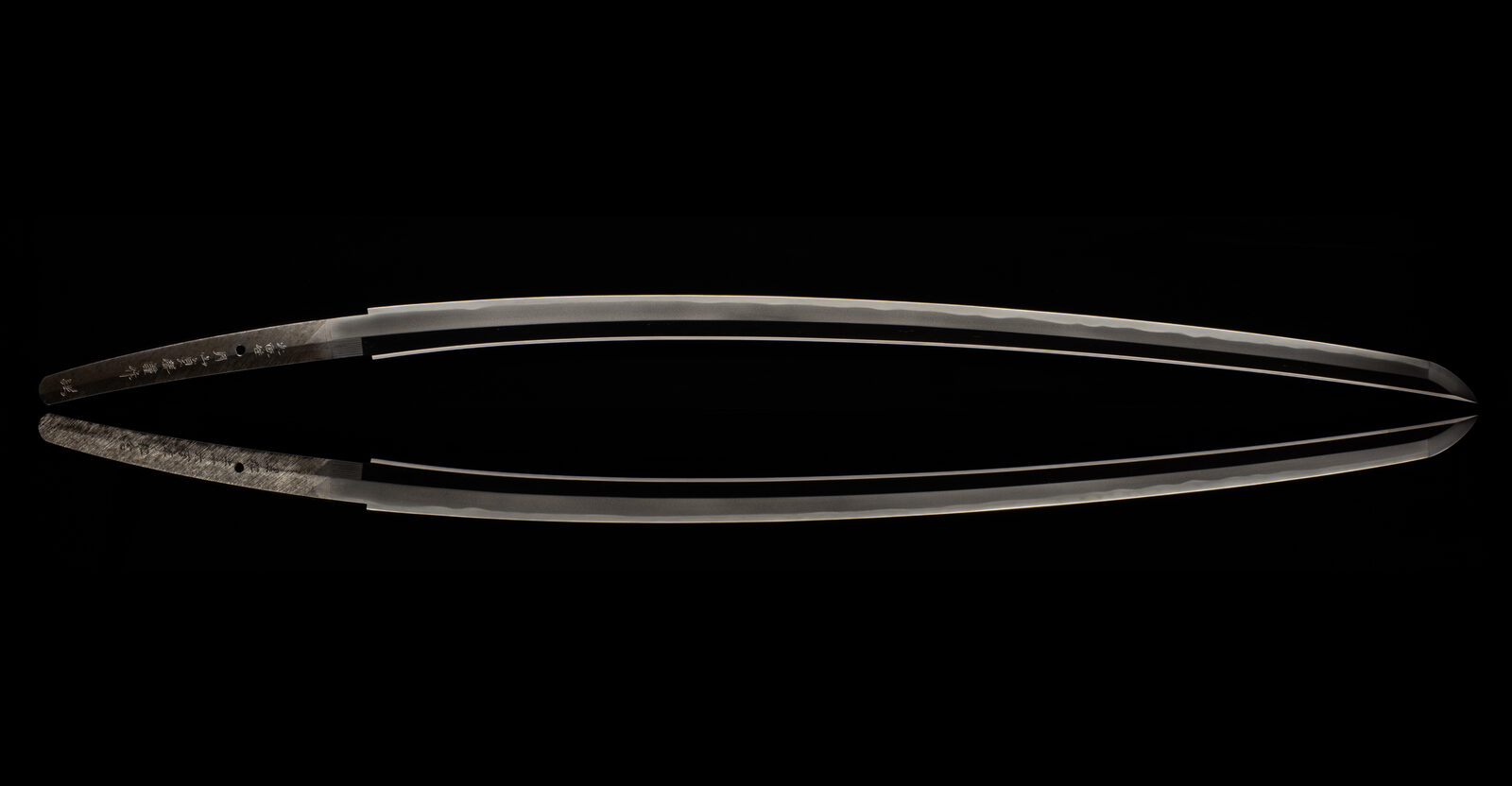
A tachi of 1940
The tachi in the photo, 68.4 cm long, was forged in 1940, the year 2600 of the imperial era (皇紀, kōki). It is in ko-nie, with a marked ayasugi-hada and a gunome-midare hamon with sunagashi, hotsure and yubashiri. It has held the NBTHK’s Tokubetsu Hozon since February 2019, and the scholar Tanobe Michihiro wrote on its scabbard in 2020 that it is an Army guntō of somewhat reduced length.
Notable works
- A tachi offered in February 1927 to the Kitano Tenmangū shrine by Marquis 前田利為 (Maeda Toshinari) at the shrine’s 1025th grand festival. It is double-edged at the point, in the manner of the Kogarasu-maru (小烏丸, Kogarasu-maru) of the Taira, with a lacquered mounting inlaid with mother-of-pearl, cranes, pine and plum. The text of the shrine’s treasure exhibition tells this.
- The 68 tachi and 43 hoko of the Ise shrine (1927–1929) and the sword of the Emperor Shōwa of 1929, with his son.
- A katana of 1935 with the signature 月山精練 (Gassan seiren), forged in Yoshino to celebrate the birth of Prince Masahito; Slough’s oshigata book on the swordsmiths of 1868 to 1945 records another almost identical one.