On this page
Quick profile
- Name
- Hachimanyama Kiyohira AT
- Kanji and reading
- 八幡山清平 (Hachimanyama Kiyohira): 八幡山 (Hachimanyama) is the place in Odawara where he lived, and 清平 (Kiyohira) the name HD
- Period
- Second half of the 17th century, Edo period; shintō (新刀, shintō) AT
- Province
- From Kaga (加賀, Kaga), from Kanazawa; he worked in Edo and in Odawara, in Sagami (相模, Sagami) HD
- School
- Kanewaka (兼若, Kanewaka), of Kaga AT
- Master
- His father, the first Kanewaka, according to the Japanese Sword Index, which says that his style resembles his father’s AT
- Generations
- The Japanese Sword Index calls him Kiyohira I, which implies a second; there is no information on him in the sources consulted AT
- Rank
- 業物 (wazamono), the 4th of the 4 grades of the 懐宝剣尺 (Kaihō Kenjaku) AT
- What is documented
- The katana of 1678, a cultural property of Ishikawa Prefecture since 1978, and a wakizashi of 1660 at the Edo-Tokyo Museum HD
- The tradition
- His birth and the lords for whom he worked are not recorded in any of the sources consulted PC
In short
According to Ishikawa Prefecture, in Edo he mixed with the city’s swordsmiths and added the new Edo style to the Kanewaka tradition, with a style of his own that made him famous. He forged his katana of 1678 on commission from 安藤対馬守藤原重治 (Andō Tsushima no Kami Fujiwara Shigeharu), who offered it to the 石清水八幡宮 (Iwashimizu Hachimangū) shrine to pray for fortune in war. Today it belongs to the 豊国神社 (Toyokuni Jinja) shrine in Kanazawa and is kept by the Ishikawa Prefectural Museum of Art.
Sections
- Kanazawa · Edo · Odawara Life and times His family, the move to Edo, Hachimanyama and his dates.
-
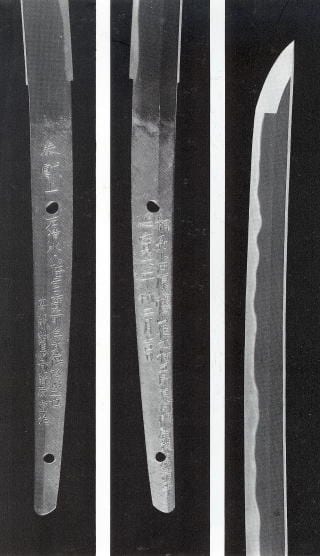 Ko-itame · notare with togari-ba
Work and style
The katana of 1678 point by point, what belongs to the school, and his signatures.
-
Ishikawa cultural property · museums
Famous works
The katana of the Toyokuni shrine, a wakizashi in Tokyo and the Yamada list.
-
Bibliography and credits
Sources
The sources consulted and the image credit.