On this page
Kantei keys
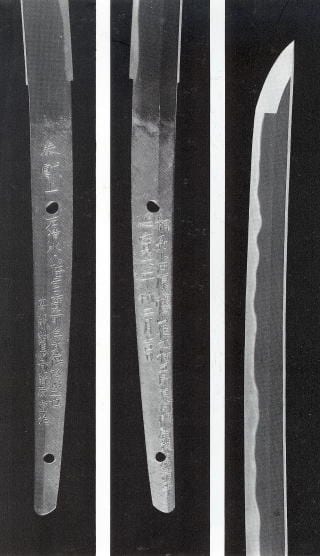
- Sugata. The katana of 1678 is in shinogi-zukuri, with an iori-mune, a thick kasane, a deep curve and a somewhat elongated chū-kissaki: an 81.5 cm blade, 3.1 cm wide, with 3.3 cm of curvature.
- Jihada. Well-forged ko-itame, with beautiful ji-nie.
- Hamon. Notare with ko-gunome and sharp points (togari-ba), in ko-nie, with ashi and a clear edge.
- Bōshi. Chū-maru, with a short turn-back.
- Nakago. Unshortened (ubu), with a kurijiri tip, ha-agari, two holes and katte-sagari file marks.
What belongs to the school
For the Japanese Sword Index, the Kanewaka school generally forges a mokume with masame and ji-nie; it tempers ō-notare and ō-gunome that tend towards hako-midare, with coarse sunagashi; the bōshi is a small midare-komi, ko-maru with a turn-back and sometimes of the Mishina type; the tang ends in a gentle kurijiri, with sujikai or katte-sagari file marks, and the signatures are almost always long. Of Kiyohira it says that his style resembles his father’s.
His signature
The Japanese Sword Index records the signatures “Kashū Fujiwara Kiyohira”, “Tsujimura Fujiwara Kiyohira”, “Kashū Kanazawa jū Kiyohira saku” and “Odawara Hachimanyama jū Kiyohira”. That of 1678 is the longest: 相州小田原八幡山住辻村五郎右衛門尉藤原清平 (Sōshū Odawara Hachimanyama jū Tsujimura Gorōemon-no-jō Fujiwara Kiyohira).