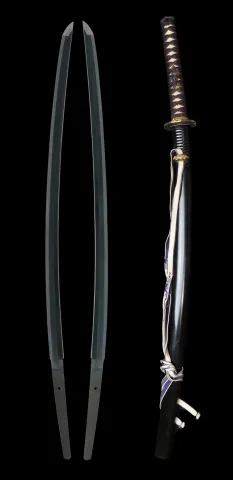
Hizen Tadayoshi
忠吉 (Tadayoshi)
Generation 4
Fourth master of the main Tadayoshi line of Saga in Hizen, active from the late 17th century until his death in 1747.
Profile
The fourth master of the main Tadayoshi line, the smiths of Saga in Hizen who served the Nabeshima clan. The son of Mutsu no Kami Tadayoshi, third of the line, he was first called Gensuke (源助); when his father died in 1686 he took over his father's common name, Hashimoto Shinzaburō (橋本新三郎). Much of his training came from his grandfather, Ōmi Daijō Tadahiro, and school tradition holds that in the old man's last years he forged blades that went out under his grandfather's name, which partly explains why signed work of his own is scarce. An order from the Saga domain dated 1694 asks him and Kawachi no Kami Masahiro for naga-wakizashi. In 1700 he received the title Ōmi Daijō (近江大掾), the same his grandfather had held, and signed Hizen no Kuni-jū Ōmi Daijō Fujiwara Tadayoshi. He kept to the house manner: a very fine konuka-hada with ji-nie and a suguha hamon. He died in 1747, close to eighty, and was followed by his son, the fifth Tadayoshi.
Rankings
- Wazamono (good) (Kaihō Kenjaku, 1797)
Swords available
-
Ōmi Daijō Fujiwara Tadayoshi, 4th generation
Katana by the fourth-generation Hizen Tadayoshi, Ōmi Daijō Fujiwara Tadayoshi, of the main line of the Hizen Tadayoshi school. According to the original seller, he was born in 1667, the son of the third Tadayoshi (Mutsu no Kami) and grandson of Tadahiro, for whom he forged blades as daisaku, and he received the title Ōmi Daijō in 1700, during the Genroku era. The blade, in shinogi-zukuri with an iori-mune, has a nagasa of 71.8 cm and a sori of 2 cm; the seller describes a very fine, uniform konuka-hada and a chū-suguha of fine, bright nie. The tang is ubu, with a single mekugi-ana, and bears the signature “Hizen Kuni jū Ōmi Daijō Fujiwara Tadayoshi”. It comes with a koshirae the seller dates to the Edo period, with matching dragon-themed fittings —tsuba, fuchi-kashira, menuki and kurigata— and a black lacquered saya with a section of kizami. The photographs also show a shirasaya, its cloth bags and a two-piece habaki in shakudō and silver foil. NBTHK Tokubetsu Hozon paper, no. 123103, dated July of Heisei 4 (1992).
67.7/100
€16,020