Hizen Tadayoshi
肥前忠吉 (Hizen Tadayoshi)
Lineage: the signature does not state the generation
Line of swordsmiths in Saga, Hizen province, serving the Nabeshima clan from the late 16th century to the beginning of the Meiji era.
Profile
Hizen Tadayoshi (肥前忠吉) names the line of swordsmiths who worked in Saga, in Hizen province, for the Nabeshima clan throughout the Edo period. The founder, Hashimoto Shinzaemon (1572–1632), trained in Kyoto from 1596 under Umetada Myōju (埋忠明寿); in 1624 he received the title Musashi Daijō (武蔵大掾) and began signing Tadahiro (忠広). The line ran to nine generations. The second, Ōmi Daijō Tadahiro (近江大掾忠広), lived longest and left the largest body of work; the third signed Mutsu no Kami Tadayoshi (陸奥守忠吉), and from the fifth onwards several held the title Ōmi no Kami (近江守). The eighth generation took part in cannon production for the domain, and the ninth stopped forging after the 1876 ban on wearing swords. School blades show a very tight ko-itame known as konuka-hada (小糠肌) and a nie-based chū-suguha with ashi, sometimes with a gentle notare or ko-gunome. Since several generations signed Tadayoshi, this entry gathers works whose signature does not show which one made them.
Swords available
-
Ōmi no Kami Tadayoshi, 5th generation
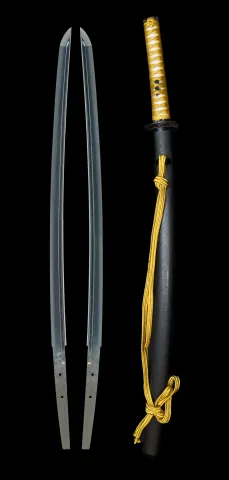
Shintō katana from Hizen signed by the fifth Tadayoshi, with bō-hi and suguha, NBTHK Tokubetsu Hozon paper, full koshirae and shirasaya. A blade of the Hizen Tadayoshi school by the fifth generation (1696–1775), who, according to the original seller, received the title Ōmi no Kami in 1750 and thereafter signed “Hizen no Kuni Ōmi no Kami Tadayoshi”, the signature found on this tang. Iori-mune, restrained sori and a broad sugata, with a motohaba of 3.1 cm, a sakihaba of 2.2 cm and a kasane of 0.8 cm; the bō-hi on both sides, visible in the photographs, lightens the blade. The original seller describes a fine, tightly forged konuka-hada jigane and a chū-suguha hamon that widens towards the kissaki. The photographs show an intact tang with a rounded tip, continuous yasurime and two mekugi-ana. It comes with a complete koshirae: a round iron tsuba carved with a dragon among clouds heightened in gold, fuchi and kashira with waves, a tsuka wrapped in yellow ito over white same, and a black lacquered saya with a granular texture. A shirasaya and a silver-foiled habaki are also included. NBTHK Tokubetsu Hozon Tōken paper, no. 1025558, issued in Reiwa 7 (2025).
58.7/100
€8,700