Hōki no Kami Nobutaka
伯耆守信高 (Hōki no Kami Nobutaka)
Family of Owari Seki swordsmiths from Mino who worked in Kiyosu and then Nagoya for the Owari Tokugawa from the late 16th century onwards.
Profile
Hōki no Kami Nobutaka is the name borne by several generations of one of the leading houses of Owari Seki, the smiths who moved from Seki in Mino to neighbouring Owari. The founder, born in Mino, received the title Hōki no Kami in the late 16th century, by tradition through the good offices of Toyotomi Hidetsugu, and early in the Keichō era set up his forge in the smiths' quarter of Kiyosu. Around 1610, when the domain seat moved from Kiyosu to Nagoya, he followed Tokugawa Yoshinao, and the family remained smiths to the Owari Tokugawa. Together with Sagami no Kami Masatsune and Hida no Kami Ujifusa he is counted among the three masters of Owari. The second generation received the title in 1633; the third first signed Nobuteru (信照) and was granted the title in 1665. They signed Hōki no Kami Fujiwara Nobutaka (伯耆守藤原信高), and the line continued in Nagoya until the end of the Edo period. The blades build on the Mino tradition with Sōshū features: a somewhat deeper curve than their contemporaries, a narrow, thin blade, and a wide midare hamon with pointed gunome and much activity.
Rankings
- Wazamono (good) (Kaihō Kenjaku, 1797)
Swords available
-
Hōki no Kami Jūdai-mago Fujiwara Nobutaka
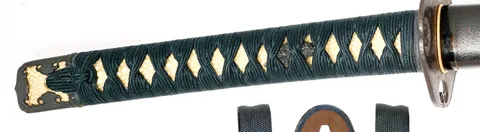
Shinshintō blade from Owari, signed and dated in the second month of Meiji 2 (1869), with a broad ō-kissaki, an ubu tang and a black ishime-lacquered koshirae. NBTHK Tokubetsu Hozon. Katana of the Owari tradition (present-day Aichi), signed “Hōki no Kami jūdai-mago Fujiwara Nobutaka”, that is, tenth-generation descendant of Hōki no Kami Nobutaka. The tang also carries the date of the second month of Meiji 2 (1869), so the blade is both signed and dated by its maker. It measures 70.5 cm of nagasa with 1.2 cm of sori and ends in a broad ō-kissaki; the motohaba is 3.22 cm and the blade loses little width towards the point, which makes for a substantial piece in hand. The original seller describes the tang as ubu with a single mekugi-ana, and the blade as polished a few years ago, free of hagire and pitting. It comes mounted in an uchigatana koshirae with a black ishime-lacquered saya that the original seller regards as contemporary with the blade; the same and the tsuka-ito of the hilt were redone last year in the same tone. NBTHK Tokubetsu Hozon papers are included. No shirasaya is offered.
75.4/100
€12,310