Hosokawa Masayoshi
細川正義 (Hosokawa Masayoshi)
Lineage: the signature does not state the generation
Line of swordsmiths from Kanuma in Shimotsuke; its second generation worked in Edo for the Tsuyama domain in the first half of the 19th century.
Profile
A line of swordsmiths from Kanuma in Shimotsuke, descended from a family of armourers, in which at least two generations signed Masayoshi. The first, Ryōsuke Masayoshi (良助正義), worked in Kanuma around 1800. His eldest son, Chikara-no-suke Masayoshi (主税佐正義), born in 1786 and died in 1858, is the best known: he trained under Suishinshi Masahide and is counted, alongside Taikei Naotane, among the master's foremost pupils and among those who carried on his return to older forging methods. He entered the service of the Matsudaira of the Tsuyama domain in Mimasaka but lived and worked in Edo, hence the signature Sakuyō Bakkashi Hosokawa Masayoshi (作陽幕下士細川正義), often followed by a stamped seal. He worked mainly in the Bizen manner, with chōji midare hamon, and less often in the Sōshū manner. His nephew Hosokawa Yoshinori (細川義規) carried the craft on in Kanuma into the first years of Meiji. Several blades by the family are cultural properties of Tochigi Prefecture, and the prefectural museum holds one by the second Masayoshi.
Swords available
-
Minamoto Masayoshi
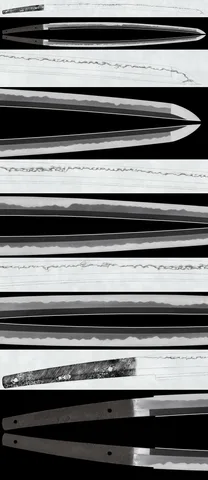
Katana signed by Minamoto Masayoshi, active in Edo around the Kyōwa era, 69.5 cm long, with NBTHK Tokubetsu Hozon and a brass koshirae described piece by piece. A blade signed by Minamoto Masayoshi, whose civil name was Hosokawa Masayoshi, active in Edo around the Kyōwa era (1801-1804). It measures 69.5 cm nagasa with 1.5 cm sori, a comfortable working length. The signature carries no date and the tang has two mekugi-ana; the originating seller does not say whether it retains its original length. The blade holds an NBTHK Tokubetsu Hozon certificate. The mounting, by contrast, is described piece by piece: a mokkō brass tsuba carved with paulownia and floral motifs, fuchi-kashira also in brass with running water and lotus flowers, and a saya lacquered in vermilion, an uncommon colour for the ensemble. No shirasaya is included. The originating seller says nothing about the condition of the blade or its polish, points worth raising before deciding.
45/100
€4,380