Ijichi Masayuki
伊地知正幸 (Ijichi Masayuki)
Lineage: the signature does not state the generation
Official smith of the Satsuma domain and the leading shinshintō maker of the province, active from 1772 to 1818.
Profile
Ijichi Masayuki (伊地知正幸) came from a Satsuma family of smiths who signed 正良 (Masayoshi) over several generations. Born in 1733 as the son and successor of the second Masayoshi, he began forging around 1772 under that name and served as official smith to the Shimazu domain; some of his signatures read 薩摩官工 (Satsuma kankō), official craftsman of Satsuma. In 1789 he was granted the title 伯耆守 (Hōki no Kami) together with Oku Motohira (奥元平); he then passed the name Masayoshi to his eldest son and replaced its second character with 幸 (yuki). With Motohira he is regarded as the central figure of Satsuma shinshintō. His blades are wide with a generous point, showing a dense itame with ji-nie and a pointed gunome hamon in coarse nie, with kinsuji and sunagashi, in the Sōshū manner. From the age of seventy he added his age to the signature, and he worked until his death in 1818, aged 86. He trained more than forty pupils. The Kyushu National Museum holds a katana of his dated 1807.
Swords available
-
Hōki no Kami Ason Masayuki
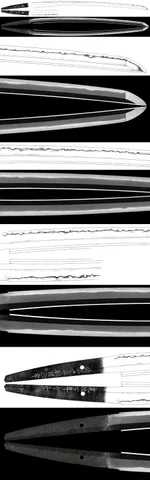
Shinshintō katana from Satsuma signed Hōki no Kami Ason Masayuki and dated to the 2nd month of Kansei 7 (1795), with NBTHK Tokubetsu Hozon paper, a koshirae with a Higo-school tsuba and a shirasaya. Katana by Hōki no Kami Ason Masayuki, a smith of Satsuma province (present-day Kagoshima) who, according to the original seller, trained in the Miyahara Masachika school, adopted the signature “Hōki no Kami Ason Masayuki” in Kansei 1 (1789) and ranks, together with Motohira, among the leading names of Satsuma shinshintō. The blade has a nagasa of 71.52 cm and a sori of 1.82 cm: wide, thick and with a long kissaki. The seller describes a well-worked ko-itame with ji-nie and chikei on a darkish jigane, a gunome-midare hamon with togari-gunome, a thick nioiguchi, sunagashi and kinsuji, and a notare bōshi with hakikake; the photographs of the hamon are consistent with this. The nakago appears ubu in the photographs, with one mekugi-ana, signed Hōki no Kami Taira Ason Masayuki and dated to the 2nd month of Kansei 7 (1795); the seller states the blade has been polished, and it carries a gold-foiled double habaki. The koshirae, which the seller describes without dating, has a kawari-nuri saya, an openwork iron Higo-school tsuba with a plum tree, gold-coloured dragon menuki and copper fuchi-kashira with plum blossoms in gold; a shirasaya is included. The photographed NBTHK origami certifies Tokubetsu Hozon Tōken (issued 1999).
68.9/100
€17,950
-
Hōki no Kami Taira Ason Masayuki
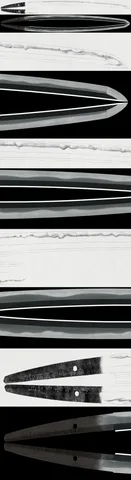
Shinshintō katana from Satsuma, signed and dated 2nd month of Kansei 6 (1794), with complete koshirae and a sayagaki by Satō Kanzan; the original seller declares NBTHK Tokubetsu Hozon Tōken. Masayuki, born Ijichi Masayoshi (the third of that name), trained under Masachika and received the title Hōki no Kami in Kansei 1; together with Motohira he is one of the two leading figures of the Satsuma school in the shinshintō period. The blade has a nagasa of 67.6 cm and a sori of 1.82 cm; it is broad and thick, with a slightly extended kissaki. According to the original seller the jigane is a fine, dark ko-itame; the hamon is a nie-deki gunome-midare with a deep nioiguchi, sunagashi and kinsuji, and the bōshi is hakikake. The photographs show an intact nakago with a single mekugi-ana, signed 伯耆守平朝臣正幸 (Hōki no Kami Taira no Ason Masayuki) and dated 寛政六年寅二月 (Kansei rokunen tora nigatsu; 2nd month of Kansei 6, 1794), the smith being 63 at the time according to the seller; single gold-foil habaki. The shirasaya bears a 1957 sayagaki by Satō Kanzan, per the original seller. The koshirae, shown complete in the photographs, comprises a kenjō-style shakudō tsuba with gold rim, shakudō nanako fuchi-kashira with gold spools, shakudō menuki of a bird in a tree and a black-lacquered saya with a wrinkled texture; the seller describes it but does not date it. An NBTHK Tokubetsu Hozon Tōken certificate is declared but does not appear in the photographs.
59.1/100
€17,310
-
Hōki no Kami Masayuki
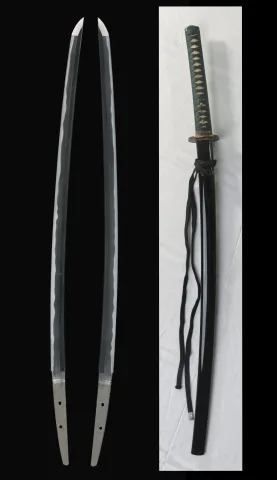
Katana signed and dated 2nd month of Kansei 11 (1799) by Hōki no Kami Masayuki, a Satsuma master of the shinshintō period, with Tokubetsu Hozon paper, ubu nakago and koshirae. Hōki no Kami Masayuki (1733–1819), official smith to the Shimazu clan and, together with Motohira, one of the two leading figures of the Satsuma school in the shinshintō period, signed this katana with the honorary title he received in 1789. According to the original seller, the blade is shinogi-zukuri with an iori-mune, showing an itame jihada with areas of mokume, Satsuma-gane and abundant ji-nie; the hamon is a notare-midare in nie-deki crossed by thick inazuma, the imozuru typical of the school. Nagasa 70.9 cm, sori 1.5 cm. The nakago, ubu according to the seller and intact in appearance in the photographs, keeps two mekugi-ana and bears the signature 伯耆守平朝臣正幸 (Hōki no Kami Taira no Ason Masayuki) on the omote and the date 2nd month of Kansei 11 (1799) on the ura. The photographs also show a shirasaya with sayagaki and a koshirae with an iron tsuba, a tsuka in green ito over same and a black lacquered saya, neither described nor dated in writing. The NBTHK awarded it Tokubetsu Hozon on 21 February 2024 (paper no. 1022305, photographed).
55.3/100
€15,060