Izumi no Kami Kaneshige
和泉守兼重 (Izumi no Kami Kaneshige)
Lineage: the signature does not state the generation
Swordsmith from Echizen who worked in Edo for the Tōdō family from the 1620s onwards.
Profile
Izumi no Kami Kaneshige (和泉守兼重) was an Edo swordsmith whose earliest dated work is from 1625. The Kokon Kaji Bikō gives Echizen as his origin, and tradition holds that he began as a maker of arrowheads (yanone). He worked for the Tōdō (藤堂) family; it is said that Miyamoto Musashi recommended him for the post, though no document supports the story. He signed first as Izumi no Daijō and later as Izumi no Kami, often adding the clan name Fujiwara. For a long time he was confused with Kazusa no Suke Kaneshige (上総介兼重), his son or pupil, who carried on the line; a jointly made blade of 1667 on which the latter gives his age as forty-three settled the question. He is commonly regarded as the teacher of Kotetsu because of the close resemblance between their work, although there is no direct proof. His blades have little curvature and keep their width towards the point; the hada is a well-forged ko-mokume with fine, bright ji-nie, and the hamon combines notare with gunome. Many carry gold-inlaid cutting-test inscriptions.
Swords available
-
Izumi no Kami Fujiwara Kaneshige
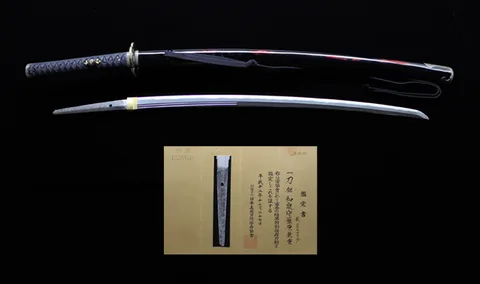
Signed katana by Izumi no Kami Fujiwara Kaneshige, from the early shintō period, with an ubu tang, Tokubetsu Hozon papers and a Matsushiro-style koshirae dated by the original seller to the late Edo period. Katana by Izumi no Kami Fujiwara Kaneshige, a smith of the earliest shintō years whom the original seller places around the Kan'ei era, presents as the teacher of Kotetsu, and whose work is rated for its superior cutting ability (ryōwazamono). The blade is in shinogi-zukuri with iori-mune, a somewhat wide mihaba, marked taper and a slightly compact chūkissaki; nagasa 70.75 cm, sori 1.7 cm. According to the seller, the jihada is itame mixed with mokume, partly nagare and masame, with dense ji-nie and abundant chikei; the hamon is ko-notare with gunome, thick ashi, deep nioi, ko-nie and sunagashi, and the bōshi runs straight to komaru with a short kaeri. The photographs show goma-bashi on the omote and futasuji-hi on the ura. The tang is ubu according to the seller and the photographs: kurijiri tip, ō-sujikai yasurime, a single mekugi-ana and a six-character signature. It comes with a Matsushiro-style koshirae that the seller dates to the late Edo period: tsuka with dark ito and gilt menuki, mokkō tsuba with gilt rim, and black lacquered saya. NBTHK Tokubetsu Hozon papers, visible in the photographs.
57.4/100
€19,880