Izumi no Kami Kinmichi
和泉守金道 (Izumi no Kami Kinmichi)
Craft name of a line of smiths of the Mishina school in Kyoto (Yamashiro), active from the late 16th century and through the Edo period.
Profile
Izumi no Kami Kinmichi is the name borne by several generations of the Mishina (三品) school of Kyoto. The founder was the second son of Kanemichi, a smith from Seki in Mino province, who moved to Kyoto with his four sons at the end of the 16th century; his brothers were Iga no Kami Kinmichi, Tanba no Kami Yoshimichi and Masatoshi. He received the title Izumi no Kami in the mid-1590s and added the character 来 (Rai) to his name, recalling the old Rai school of Kyoto, which gives the usual signature 和泉守来金道 (Izumi no Kami Rai Kinmichi). His successors kept both title and signature, often headed by the chrysanthemum crest, the kikumon (菊紋), cut into the tang, and some signed with the title Daihōshi Hōkyō (大法師法橋). The third generation worked roughly from the Keian to the Enpō era (about 1648–1680), with suguha or gunome and ko-midare hamon in the Kyoto manner. A blade of this generation is held by the London Museum.
Rankings
- Wazamono (good) (Kaihō Kenjaku, 1797)
Swords available
-
Izumi no Kami Rai Kinmichi
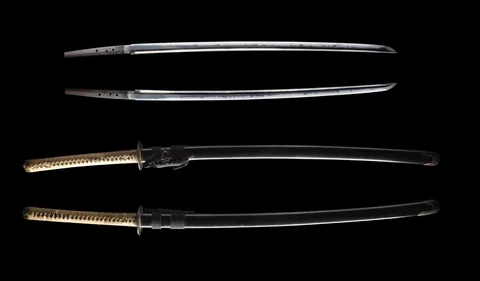
Rai Kinmichi line of Kyoto, with the imperial kikumon before the signature and an inscription declaring the blade forged in the master's ninety-second year. 75.2 cm. Izumi no Kami Rai Kinmichi heads one of the historic lines of Kyoto, within the Mishina school, and held the privilege of cutting the imperial kikumon before the signature. The name passed through five generations; the NBTHK attributes this blade to the second or the third, on style and signature, without choosing between them, and places it between the Keian and Enpō eras (1648-1681), in early Edo. It measures 75.2 cm of nagasa with 1.0 cm of sori, a long blade of shallow curvature. The reverse of the tang bears the inscription 大法師法橋九十二造之 (probable reading: Daihōshi Hokkyō kyūjūni kore o tsukuru), stating that the blade was forged when the master was ninety-two; Daihōshi Hokkyō was an honorary religious title within the line, and the works that carry it are known as Ōkurikara Rai Kinmichi. The blade holds NBTHK Tokubetsu Hozon papers and comes with shirasaya, koshirae, a travel bag and a maintenance kit.
41.8/100
€9,530