Kashū Kiyomitsu
加州清光 (Kashū Kiyomitsu)
Name borne by swordsmiths of the Fujishima school in Kaga from the mid-Muromachi period to the end of Edo; its best-known generation worked in Kanazawa in the 17th century.
Profile
Kiyomitsu (清光) is a name carried by more than ten generations of Kaga swordsmiths of the Fujishima (藤島) school, working in what is now Kanazawa from the mid-Muromachi period until the end of Edo. The best known is the sixth generation, Chōbei, called Hinin Kiyomitsu (非人清光). After the Kanbun-era famine he entered, around 1670, the relief shelter the domain ran at Kasamai (笠舞), where the lord Maeda Tsunanori (前田綱紀) supplied him with a forge and materials and bought his blades. He died in 1687, and his son and grandson went on working there. He signed Kashū Kanazawa-jū Fujiwara Kiyomitsu (加州金沢住藤原清光) or simply Kiyomitsu, sometimes noting that the blade was made at Kasamai. Blades of this period are credited with a clear ko-itame jigane, tightly forged, and a hamon in suguha or chōji-midare. Tradition links the name with Okita Sōji (沖田総司) of the Shinsengumi. Since the signature rarely states the generation, this entry covers the whole line.
Swords available
-
Kashū Kiyomitsu
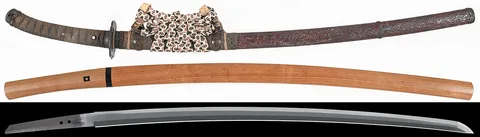
Katana signed 清光 (Kiyomitsu), of the Kaga lineage, with NBTHK Tokubetsu Hozon Tōken papers, a tachi-style mounting and a shirasaya. Katana by Kashū Kiyomitsu, a lineage of smiths in Kaga province active from the late Muromachi period to the end of Edo. The original seller places it around the Kanbun era (1661–1673) and notes that the name Kashū Kiyomitsu is associated with Okita Sōji of the Shinsengumi; this refers to the lineage, not to this blade. It measures 72.5 cm in nagasa, with 2.0 cm of sori, a motohaba of 3 cm and a kasane of 6.5 mm at the base. The photographs show a polished shinogi-zukuri blade with a medium kissaki. The tang bears the two-character signature 清光 (Kiyomitsu) on the omote and two mekugi-ana; its shape and the position of the signature point to an intact tang. The NBTHK certified it Tokubetsu Hozon Tōken in 2026, attributing it to Kiyomitsu of Kashū. It comes with a plain wooden shirasaya and a tachi-style mounting: a tsuka wrapped over same, a mokkō-shaped iron tsuba, two hangers (ashi) with their cord and a dark red lacquered saya with relief texture. The original seller neither describes nor dates the mounting, which is documented only in the photographs.
58.1/100
€7,790