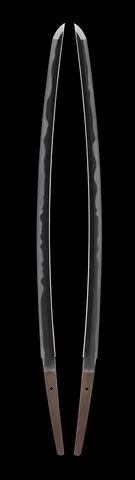
Katsumura Norikatsu
勝村徳勝 (Katsumura Norikatsu)
Lineage: the signature does not state the generation
Retainer smith of the Mito domain in Hitachi, active in Mito and Edo in the mid-19th century and working in the Yamato manner.
Profile
Katsumura Norikatsu (勝村徳勝), whose name is also read Tokukatsu, was born in Mito in 1809 into a family of domain retainers and died in 1872. He trained under the Mito smith Norimune (徳宗) and in the 1850s moved to Edo, where he studied further with Unju Korekazu (運寿是一) and Hosokawa Masayoshi (細川正義) and worked at the domain residence in Koishikawa. As a smith in the service of the Mito domain under Tokugawa Nariaki (徳川斉昭), he took up the Yamato style at the lord's request: wide, thick blades, a strongly marked masame hada and a suguha hamon in nie, sometimes with a gentle notare, nijūba and sunagashi. His usual signature was 水府住勝村徳勝作之 (Suifu-jū Katsumura Norikatsu kore o saku), Suifu being the literary name for Mito, and on some blades he recorded that they were forged in Edo. By tradition his son carried on the name as the second generation, though very few of his works are known. One of his katana is designated a cultural property by the city of Mito.
Swords available
-
Suifu-jū Katsumura Tokukatsu
Katana signed and dated 1863 by Katsumura Tokukatsu, smith to the Mito domain, with an NBTHK Tokubetsu Hozon certificate and a koshirae with black-lacquered saya bearing gold crests. Katana by Katsumura Tokukatsu (勝村徳勝), a smith in the service of the Mito domain in the late Edo period. According to the original seller, he was born in 1806 as the son of a Mito samurai, learned forging from the domain smith Sekinai Tokumune and, by order of Tokugawa Nariaki, went to Edo in 1852 to train under Hosokawa Masayoshi and Unju Korekazu; from 1861 he worked at the domain residence in Koishikawa. The blade, with a nagasa of 70.6 cm and a sori of 2.0 cm, is signed “Suifu-jū Katsumura Tokukatsu saku kore” and dated to the 8th month of Bunkyū 3 (1863). The original seller describes it as an unusual work within his output: tightly knit ko-itame, an ō-notare midare hamon with abundant kinsuji and sunagashi, and a bōshi returning almost in ichimai, in the manner of the great Sōshū masters such as Gō Yoshihiro. In the photographs the tang appears intact, with a single mekugi-ana and an even patina. It comes with a koshirae featuring a black-lacquered saya decorated with gold crests, a tsuka with same and black wrap, an iron tsuba and a green sageo. The blade holds an NBTHK Tokubetsu Hozon Tōken certificate, whose origami is shown in the photographs.
68.2/100
€17,310