On this page
National Treasures
| Work | Designation | Where it is |
|---|---|---|
| Tachi signed “Masatsune” at the Tokugawa Art Museum | Important Cultural Property in 1953; National Treasure in 1954 | Tokugawa Bijutsukan, Nagoya |
| Tachi signed “Masatsune” of the Hachisuka house | Designated in 1933 under the old law; National Treasure in 1952 | Fukuyama Museum of Art (Hiroshima) |
| Tachi signed “Masatsune” at the Tokyo National Museum | Designated in 1931 under the old law; National Treasure in 1952 | Tokyo National Museum; it belongs to the Agency for Cultural Affairs |
| Tachi signed “Masatsune” at the Kyoto National Museum | Designated in 1937 under the old law; National Treasure in 1961 | Kyoto National Museum; it belongs to the Agency for Cultural Affairs |
The Japanese Wikipedia counts five “Masatsune” tachi that are National Treasures; in the database of the Agency for Cultural Affairs the four in the table have been found. It remains to be checked which of the records corresponds to the tachi of the Toda house of Ōgaki that the Japanese Wikipedia cites.
The tachi of the Tokugawa Art Museum
The two records of the Tokugawa Art Museum relate that it was a gift from the shōgun in 1745 (Enkyō 2). One of them and the Japanese Wikipedia say that the shōgun was Tokugawa Yoshimune; the other says Tsunayoshi, who had died in 1709, so the first is followed here.
Important Cultural Properties
| Work | Designation | Where it is |
|---|---|---|
| Tachi signed “Masatsune” of the Arima house of Maruoka (Echizen) | Important Cultural Property in 1950 | Agency for Cultural Affairs (Ueno, Tokyo) |
| Tachi signed “Masatsune” of the Ogasawara house of Kokura (Buzen), with its black-lacquer mounting | Important Cultural Property in 1950 | The NBTHK’s Japanese Sword Museum, Tokyo; 78.4 cm |
| Tachi signed “Masatsune” of the Kōsetsu Bijutsukan | Important Cultural Property in 1950 | Kyoto National Museum, on deposit; 77.9 cm |
Other works in museums
- A katana with a folded signature (折返銘, orikaeshi-mei): a shortened tachi whose signature was folded over onto the nakago to preserve it. It belonged to the Date house of Sendai and is at the Kyoto National Museum, which gives it as an Important Art Object (重要美術品, jūyō bijutsuhin).
- A signed tachi at the Kyūshū National Museum, in Dazaifu, of 74.8 cm, with a hi and a kurikara at the base; its record indicates no national designation.
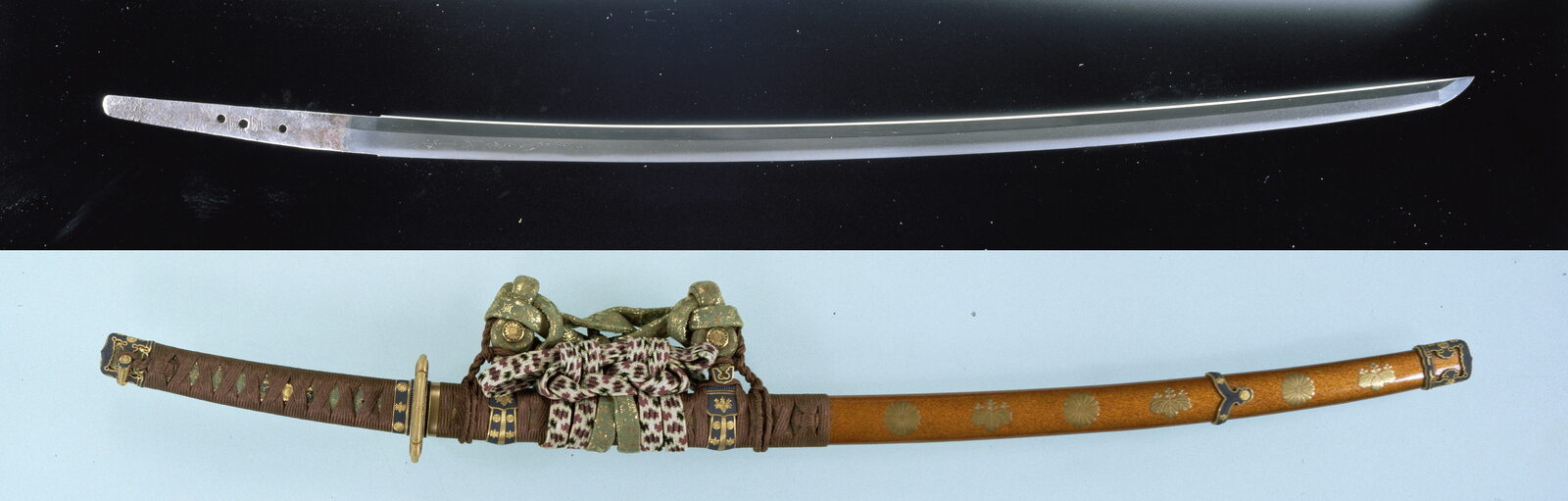
- The tachi F-183 of the Tokyo National Museum, a blade of the 12th century with its itomaki-no-tachi mounting of the 18th century with chrysanthemum and paulownia crests (the photo on this page).
In the old lists
He does not appear in the cutting lists (業物, wazamono): the only Masatsune in the list given by the English Wikipedia is Sagami no Kami Masatsune, a shintō swordsmith.