Mutsu no Kami Ōmichi
陸奥守大道 (Mutsu no Kami Ōmichi)
Lineage: the signature does not state the generation
Line of Mino smiths signing Mutsu no Kami Ōmichi, begun by Kanemichi of Seki in the second half of the 16th century.
Profile
Ōmichi (大道), also read Daidō, is the name taken by Kanemichi (兼道), a smith of Seki in Mino province, in the second half of the 16th century. Tradition holds that in 1569 he forged a blade for Emperor Ōgimachi, who granted him the character 大 (ō) and the title Mutsu no Kami, after which he signed Ōmichi. Dated blades are known from 1574 to 1590. He is regarded as the founder of the Mishina (三品) school, Mishina being the family name: according to tradition he moved to Kyoto around the Bunroku era with his four sons, among them Iga no Kami Kinmichi, Tanba no Kami Yoshimichi and Etchū no Kami Masatoshi, who established the school in the capital at the start of the Edo period. His work belongs to the late Muromachi Mino manner: itame hada with masame, a hamon of gunome and notare, sometimes suguha in ko-nie. The signature alone does not tell which generation made a blade; this entry gathers the blades that bear it.
Swords available
-
Mutsu no Kami Ōmichi
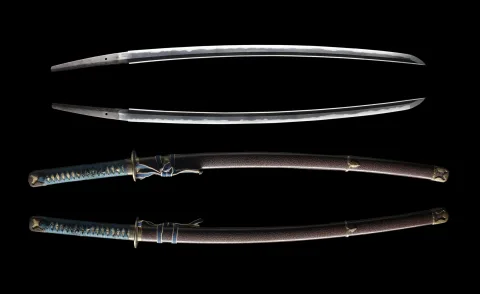
Katana signed Mutsu no Kami Ōmichi (Daidō), founder of the Mishina school, with an NBTHK Tokubetsu Hozon certificate and a complete brown-lacquer koshirae with karakusa motif. Katana signed by Mutsu no Kami Ōmichi (Daidō), a Mino-province smith credited with founding the Mishina school of Kyoto, whose sons became known as the Kyōto Gokaji. The blade measures 71.9 cm in nagasa with a sori of 1.9 cm; the photographs show an undulating gunome and notare hamon in clear nioi and a well-preserved bōshi, in presentable polish. The tang appears intact, with a single mekugi-ana, visible yasurime and the five-character signature on the omote. The original seller warns of a couple of minor kitae-kizu; one of them can be seen next to the machi in a detail photograph. The mounting is a complete koshirae: brown lacquered saya with a raised karakusa pattern, engraved brass kojiri, kurikata and koiguchi, brass fuchi-kashira with karakusa, gilt menuki depicting warriors (musha-zu) and an iron tsuba with an openwork design of two overlapping masu and a brass rim; the blue-green tsuka wrap is aged, as the seller himself acknowledges. It comes with an NBTHK Tokubetsu Hozon Tōken certificate (no. 1026018, 16 February 2026) and a shirasaya.
55.5/100
€16,020