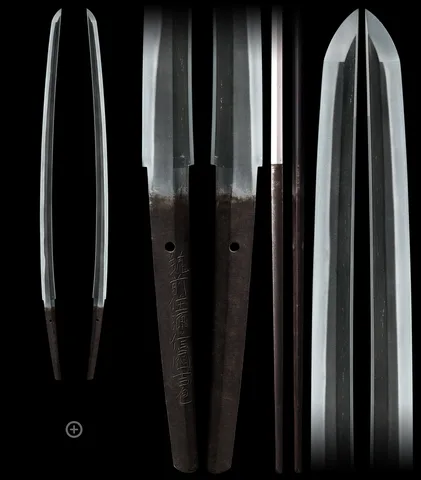
Nobukuni Yoshikane
信国吉包 (Nobukuni Yoshikane)
Lineage: the signature does not state the generation
Name used by several smiths of the Chikuzen branch of the Nobukuni school in Fukuoka, active from the mid-17th to the early 18th century.
Profile
Yoshikane (吉包) is a name borne by several smiths of the Chikuzen branch of the Nobukuni school, retainers of the Kuroda lords of Fukuoka; the signature alone does not tell which of them made a given blade. The best known is Nobukuni Sukezaemon Yoshikane, fourteenth in the Nobukuni line, son of Yoshitsugu and grandson of Yoshisada, who followed the Kuroda from Buzen to Chikuzen and made the family's reputation with his socketed fukuro-yari (袋槍) spears. He worked in Hakata around the Kanbun era and died in 1693. His son Shigekane (重包) also signed Yoshikane early in his career, and another Yoshikane of the family, known as Kansuke, died in 1723. The usual signature reads Chikuzen-jū Minamoto Nobukuni Yoshikane (筑前住源信國吉包); one blade records that it was forged from nanban-tetsu (南蛮鉄), imported iron. The work attributed to the name is mostly gunome mixed with midare or ko-notare, alongside the chōji-midare typical of the school. A sword and a wakizashi by the Yoshikane who died in 1693 are held by the Fukuoka City Museum.
Swords available
-
Chikuzen Nobukuni Yoshikane
Nobukuni school of Chikuzen, Kanbun era, with an ubu tang of a single mekugi-ana, 2.1 cm of sori, NBTHK Tokubetsu Hozon papers, koshirae and shirasaya. A work of the Nobukuni school of Chikuzen, one of the two principal shintō lines of that province, placed by the original seller in the Kanbun era (1661-1673). The blade measures 70.4 cm of nagasa with a sori of 2.1 cm: a pronounced curve for a piece of its period, giving the outline a clearly visible arc. Sunagashi and kinsuji can be seen along the edge, activities that speak of careful forging. The tang remains ubu, unshortened, with a single mekugi-ana, so the signature survives in full; it bears no date. The blade carries NBTHK Tokubetsu Hozon papers. It comes with koshirae and shirasaya, although the original seller does not describe the fittings of the mounting and makes no statement about the blade's state of preservation.
72.7/100
€9,730
-
Chikuzen-jū Minamoto Nobukuni Yoshikane
An early Edo work by a smith to the Kuroda house, with an ichimai bōshi, funbari preserved at the tang and a condition the original seller calls exceptional. Yoshikane worked in Chikuzen as a smith to the Kuroda house and was the father of Shigekane, who forged the sword of the shōgun Yoshimune. This katana, early Edo and without a carved date, measures 69.1 cm nagasa with 1.3 cm sori. The original seller singles out its state of preservation: it keeps an ichimai bōshi and the funbari at the tang, a degree of health he considers remarkable for some 350 years. He also notes the rarity of the work, a broad suguha over koshiba that he reads as a copy of Yosozaemon Sukesada, and states a single mekugi-ana. NBTHK Tokubetsu Hozon papers accompany the blade, which comes with koshirae and shirasaya.
70.7/100
€11,700