Ōmi Daijō Tadahiro
近江大掾忠広 (Ōmi Daijō Tadahiro)
Swordsmith of Saga in Hizen, second master of the Tadayoshi line; active from 1632 to 1693, holding the title Ōmi Daijō from 1641.
Profile
The youngest son of the first Tadayoshi (忠吉), he was born in 1614 as Hashimoto Heishirō and took over the family forge in Saga, Hizen, when his father died in 1632, at about nineteen. He worked under the name Tadahiro throughout his life and never signed Tadayoshi. In 1641 he received the honorary title Ōmi Daijō (近江大掾), which from then on appears in his usual signature, Hizen no Kuni-jū Ōmi Daijō Fujiwara Tadahiro (肥前国住近江大掾藤原忠広). His career lasted more than sixty years, until his death in 1693, and he left more work than any other master of the line; he is also counted among the most prolific smiths of the whole shintō period. His blades show konuka-hada (小糠肌), the very tight ko-itame associated with the Hizen school, and his most characteristic hamon is a nie-based suguha; midareba is less common. His eldest son carried the line on as the third generation, Mutsu no Kami Tadayoshi.
Rankings
- Ō-wazamono (excellent) (Kaihō Kenjaku, 1797)
Swords available
-
Ōmi Daijō Fujiwara Tadahiro
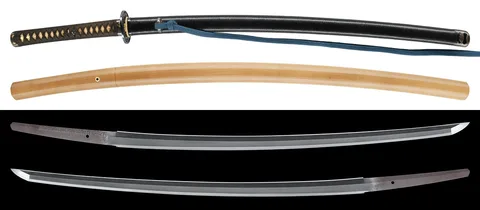
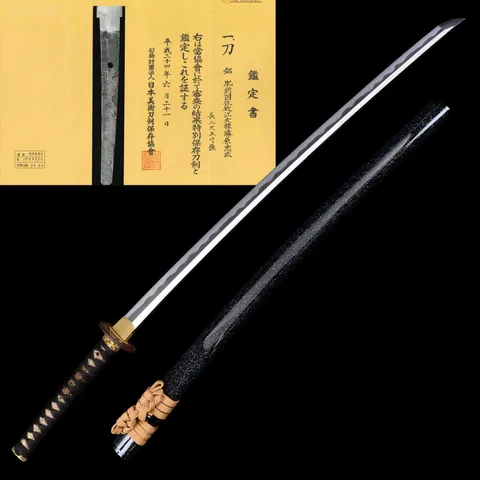
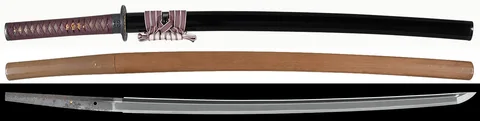
Katana by Ōmi Daijō Tadahiro, early Edo master of Hizen, with a signed ubu nakago, shirasaya and a black sendan-maki lacquer koshirae; blade and mounting both hold NBTHK Tokubetsu Hozon papers. A blade by Ōmi Daijō Tadahiro, second generation of the Hizen Tadayoshi line: son of the first Tadayoshi, he took over the forge at nineteen, worked as smith to the Saga domain and received the title Ōmi Daijō in 1641; he is ranked among the ō-wazamono. According to the original seller, the blade dates from the early Edo period, around 1648, and is described as sound. Shinogi-zukuri with iori-mune, 71.8 cm nagasa and 1.6 cm sori, a wide mihaba and a slightly extended chū-kissaki. Fine ko-itame with ji-nie and chikei, and a bright suguha in nie and nioi, with a straight bōshi turning back in ko-maru. The nakago is ubu, with katte-agari yasurime, one mekugi-ana and the full signature 肥前國住近江大掾藤原忠廣 (Hizen no Kuni-jū Ōmi Daijō Fujiwara Tadahiro). Two-piece gold-foil habaki. It comes with a shirasaya and an uchigatana koshirae whose saya is lacquered black in sendan-maki style, with autumn-grass fittings: fuchi-kashira with gold and silver chrysanthemums, a signed fuchi, floral menuki and a round openwork tsuba. NBTHK Tokubetsu Hozon Tōken paper (no. 122876, 1992) for the blade and Tokubetsu Hozon Tōsōgu (no. 221589, 1992) for the mounting.
80.1/100
€28,970
-
Ōmi Daijō Fujiwara Tadahiro
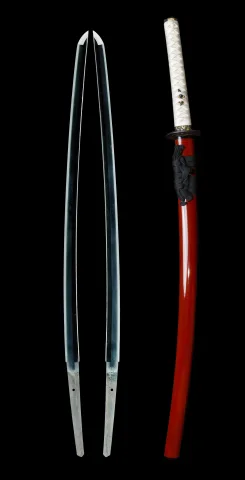
Katana by the second-generation Tadahiro of Hizen, signed and ubu, with Tokubetsu Hozon papers and a vermilion-saya koshirae whose fuchi-kashira, signed Masakuni, also carries Tokubetsu Hozon papers. Blade by Ōmi Daijō Fujiwara Tadahiro, second generation of the main Hizen line and son of Hizen Tadayoshi, who received the title Ōmi Daijō in Kan'ei 18 (1641) and worked until Genroku 6 (1693). It measures 70.1 cm in nagasa with 1.2 cm of sori. According to the original seller, the jigane is a very tight ko-itame showing the school's characteristic konuka-hada, and the hamon is a chū-suguha with a bright, even nioiguchi ending in a ko-maru bōshi. The tang is ubu with a single mekugi-ana and bears the signature Hizen no Kuni-jū Ōmi Daijō Fujiwara Tadahiro, undated. The photographs show the NBTHK Tokubetsu Hozon origami for the blade. The katana is mounted in a koshirae with a vermilion-lacquered saya, a tsuka of white ito over same, an iron tsuba with radiating grooves and openwork, and a fuchi-kashira signed Masakuni depicting a hawk on the watch and a monkey hiding in a cave, which has its own Tokubetsu Hozon fittings paper. It comes with a shirasaya, cloth bags and a silver-foil habaki.
71.2/100
€14,740
-
Ōmi Daijō Fujiwara Tadahiro
Ubu katana signed by Ōmi Daijō Fujiwara Tadahiro, second generation of Hizen Tadayoshi, with Tokubetsu Hozon Tōken certificate, a sayagaki attributed to Satō Kanzan and an aogai koshirae described as a period mounting. Katana signed Hizen no Kuni jū Ōmi Daijō Fujiwara Tadahiro, the work of the second generation of the Hizen Tadayoshi house, who received the title Ōmi Daijō in 1641 and is ranked among the shintō smiths as jōjō-saku and ō-wazamono. A long shinogi-zukuri blade with a nagasa of 76.6 cm and a sori of 1.2 cm, with an ubu tang, a single mekugi-ana and the complete signature, as the photographs show. According to the original seller, the jigane is the konuka-hada characteristic of Hizen and the hamon a custom-order gunome-midare, unusual for this smith, with chōji-ashi, sunagashi and kinsuji; the photographs show a recent polish and a clear, undulating temper line. The blade holds an NBTHK Tokubetsu Hozon Tōken certificate, legible in the photographs, and comes with a shirasaya bearing a sayagaki attributed to Satō Kanzan. It is accompanied by a koshirae the seller describes as a period mounting: a black-lacquer saya with aogai, a maki-same hilt with dragon menuki and gilt fuchi-kashira, and an openwork iron tsuba with pine and plum motifs.
56.9/100
€29,100
-
Hizen Ōmi Daijō Fujiwara Tadahiro
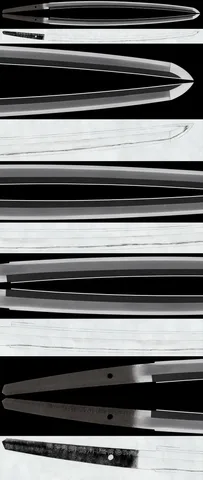
Hizen shintō with a single mekugi-ana and NBTHK Tokubetsu Hozon papers, in a koshirae with a square nanban tsuba of pierced dragon and gold-highlighted nō-prop fuchi-kashira. Ōmi Daijō Fujiwara Tadahiro is the name that followed the first Tadayoshi at the head of the Hizen school in Saga province, and much of the house's seventeenth-century output is signed with it. This blade measures 68.48 cm of nagasa with 1.67 cm of sori. The tang retains a single mekugi-ana and the signature bears no date. The blade holds NBTHK Tokubetsu Hozon papers. The mounting deserves attention of its own: a square nanban tsuba with a pierced dragon, an imported fitting uncommon in a Japanese koshirae; iron fuchi-kashira carved with nō theatre implements picked out in gold; menuki in the form of a jūmonji-yari; and a saya lacquered in glossy black. No shirasaya is included, so the blade can only be kept inside its mounting until one is commissioned.
47.6/100
€12,950
-
Ōmi Daijō Fujiwara Tadahiro
Katana signed by Ōmi Daijō Fujiwara Tadahiro of the Hizen school, 67.8 cm nagasa, with an NBTHK Tokubetsu Hozon Tōken certificate. It comes with a black-lacquered koshirae and a shirasaya. Edo-period katana signed "Hizen no kuni jū Ōmi Daijō Fujiwara Tadahiro", the name of the second master of the Hizen Tadayoshi line. The original seller recalls that the smith received the Ōmi Daijō title in 1641, places him among the shintō jō-saku and credits him with the ō-wazamono cutting grade. The blade measures 67.8 cm nagasa with 1.0 cm sori and has no hi; the photographs show a clean polish, a well-shaped kissaki and a dense jihada, with the hamon visible along its whole length. The nakago keeps the full signature and shows three mekugi-ana, two of them plugged with umegane, the working hole sitting very close to the machi. It is accompanied by a koshirae with black-lacquered saya, an openwork iron tsuba with a dragon and a bird, dark fuchi-kashira bearing a cross-in-circle mon, gilt dragon menuki over same and purple wrapping, plus a silver habaki and a wooden shirasaya. The origami photographed is the NBTHK Tokubetsu Hozon Tōken certificate.
40.9/100
€9,410