Onizuka Katsukuni
鬼塚勝国 (Onizuka Katsukuni)
Lineage: the signature does not state the generation
Swordsmith of Mito in Hitachi province, active towards the end of the Edo period (shinshintō).
Profile
Little is known of Onizuka Katsukuni beyond his signature: 鬼塚九郎源勝国 (Onizuka Kurō Minamoto Katsukuni), giving his family name, the common name Kurō and the Minamoto clan name. He worked in Mito, Hitachi, in the late Edo period, and his known blades date from around 1860. The reference works do not record his teacher or school.
Swords available
-
Onizuka Kurō Minamoto Katsukuni
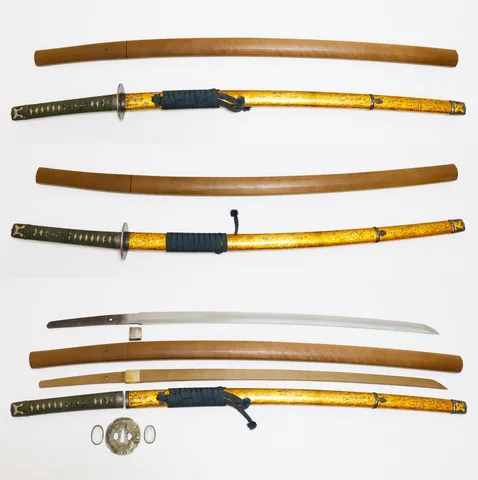
Forged before the deity of the Hachiman shrine in Mito on New Year's Day of Ansei 7 (1860), with an ubu tang, a solid silver habaki and a han-tachi koshirae. The inscription reads “Onizuka Kurō Minamoto Katsukuni, resident of Mito, Hitachi province. Made with spirit at the age of twenty-nine”, and on the reverse: “forged before the deity of the Hachiman shrine on New Year's Day, first month of Ansei 7 (1860), year of the monkey”. The original seller is explicit about what is not known: Katsukuni does not appear in the indexes of smiths, nor is any Onizuka family recorded among the retainers of the Mito domain; his hypothesis is a smith brought in from another province for the Shirahatayama arms manufactory, built beside the shrine itself in 1857. The blade measures 71.9 cm nagasa and 1.5 cm sori, with 3.2 cm motohaba, 2.4 cm sakihaba and 0.8 cm munekasane, and shows a very regular succession of togari-gunome. The tang is ubu, with kiri yasurime, ha-agari kurijiri and a single mekugi-ana; the habaki is solid silver with koshi-yūjō yasurime. NBTHK Tokubetsu Hozon papers dated 31 May 2024. The koshirae is han-tachi, 101.3 cm long: gold-lacquered saya with a mushikui motif, a brass mokkō-gata tsuba with an oni and Shōki in katakiri-bori, amaryū menuki in shibuichi with gold iroe, shibuichi chirimen-ji fuchi-kashira with senbori and two crests, and a white same tsuka with tsumami-maki in willow-green silk.
64.1/100
€12,310