Osafune Moromitsu
師光 (Osafune Moromitsu)
Lineage: the signature does not state the generation
Signature name of the Osafune school in Bizen, with dated works from the late 14th and early 15th centuries.
Profile
Moromitsu is a signature name of the Osafune school in Bizen, spanning the late Nanbokuchō and early Muromachi periods. Reference works place it in the Kozori group, the loose label given to Osafune smiths of that time who stood outside the main branches such as those of Kanemitsu and Chōgi and whose affiliation is unclear; Moromitsu is one of the group's leading names. Dated tachi are known from the Eiwa era (1376) into the Ōei era: Kitano Tenmangū shrine in Kyoto holds one signed Bishū Osafune Moromitsu and dated 1402. Given how far apart these dates are, it is not certain that a single smith is involved, and the sources do not clearly separate the generations. Tradition counts Moromitsu, together with Morimitsu and Yasumitsu, among the three "Mitsu" of the Ōei era. His tachi tend to have a pronounced koshizori, and the hamon mixes gunome and midare with broad bases, in keeping with late 14th-century Bizen work.
Swords available
-
Osafune Moromitsu
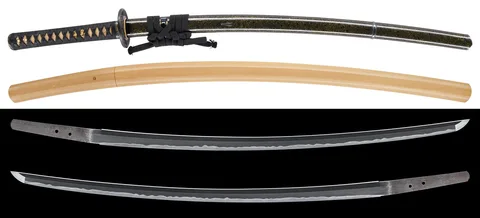
Blade by Osafune Moromitsu of the Bizen Kozori group, signed and dated Shitoku 2 (1385) and designated Jūyō Tōken; ubu nakago, with shirasaya and a koshirae whose tsuba holds Tokubetsu Hozon Tōsōgu papers. Blade by Osafune Moromitsu, a Bizen smith of the Kozori group, active in the late Nanbokuchō period; the NBTHK documentation shown in the photographs describes him as the son of Tomomitsu and the father of Morimitsu. Shinogi-zukuri with iori-mune, a deep sori of 2.2 cm and chū-kissaki, over a nagasa of 65.6 cm. The jigane is a tightly forged itame mixed with mokume, with thick jinie, abundant chikei and faint utsuri; the hamon combines ko-chōji, ko-gunome and ko-notare with ashi and yō, nioi-deki with ko-nie and fine sunagashi. The bōshi runs in notare and midarekomi, returning in komaru. The nakago is ubu, with kurijiri tip, katte-sagari yasurime and two mekugi-ana; it is signed “Bishū Osafune Moromitsu” and dated on the reverse to the 3rd month of Shitoku 2 (1385). The NBTHK records it as a tachi. It comes with a shirasaya and a koshirae: black lacquered saya with gold flecks, full-wrap same on the tsuka, gilt shishi menuki and fuchi-kashira with plum blossoms; the tsuba, an unsigned iron Akasaka piece, has its own Tokubetsu Hozon Tōsōgu paper. Designated Jūyō Tōken at the 64th session (November 2018).
70.1/100
€66,950