Ōsaka Yoshimichi
大阪吉道 (Ōsaka Yoshimichi)
Mishina school swordsmith who founded the Ōsaka branch, in Settsu; active in the mid-17th century.
Profile
Yoshimichi was the second son of the first Tanba no Kami Yoshimichi of Kyoto, head of the 三品 (Mishina) school, and learned the craft from his father. Born around 1598, he received the honorary title of Tanba no Kami around the Shōhō era (1644-1648) and settled in Ōsaka, where he founded the branch known as Ōsaka Tanba. Works from 1667, when he was about seventy, are attributed to him. He kept to the family style: 簾刃 (sudare-ba), a hamon on a suguha or gentle notare base whose inner pattern recalls a bamboo blind, and its variant 菊水刃 (kikusui-ba). He signed Tanba no Kami Yoshimichi. His second son set up his own branch as Yamato no Kami Yoshimichi, while the Tanba no Kami title passed to his successors in Ōsaka for several generations, so the same signature appears on blades by more than one smith of the line.
Rankings
- Yoki-wazamono (very good) (Kaihō Kenjaku, 1797)
Swords available
-
Tanba no Kami Yoshimichi
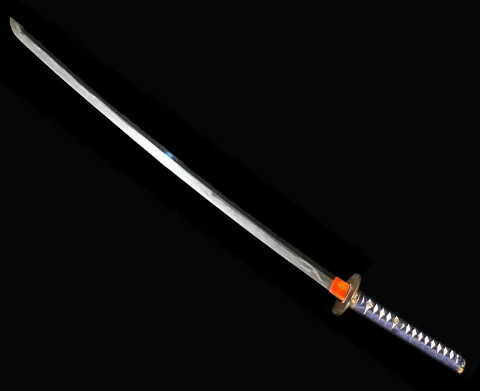
Shintō katana by Tanba no Kami Yoshimichi of Osaka, signed, with NBTHK Tokubetsu Hozon paper, mounted in koshirae and accompanied by a shirasaya. Blade by Tanba no Kami Yoshimichi, of the Osaka branch of the Yoshimichi school, working in Settsu province in the early Edo period. According to the original seller, the smith was the second son of the first Kyoto Yoshimichi, also worked in Fushimi, is ranked jōsaku among shintō smiths and is regarded as ryōwazamono. The seller places the blade around the Jōō era (1652). It measures 69.9 cm in nagasa with 1.3 cm of sori, a motohaba of 3.21 cm and a sakihaba of 2.38 cm. The seller describes a broken sudare-ba hamon with nie. The nakago bears the signature "Tanba no Kami Yoshimichi" and, in the photographs, two mekugi-ana; the tip keeps its shape. The sword comes in shirasaya and with a complete koshirae: a black textured lacquer saya, a tsuka with dark blue ito over same, gilt warrior menuki and fuchi-kashira, and a lobed iron tsuba inlaid with autumn grasses and a dragonfly. The seller neither describes nor dates the mounting. The NBTHK Tokubetsu Hozon paper is photographed, dated Reiwa 4 (2022).
51/100
€10,380