On this page
Two manners
He made classical tachi and tantō in suguha, close to Kunimitsu and Kunitoshi (above all unshortened tachi), and blades in ko-notare and gunome with plenty of nie, in the Sagami manner. Sesko warns that the difference from Kunimitsu is not “night and day”, as old sources say.
Sugata
It is often repeated that he made few tachi, but Sesko counts as many signed tachi as signed tantō, and many heavily shortened, unsigned tachi are attributed to him. Of his five pieces designated by the State, three are long blades, and of some fifty NBTHK Jūyō, more than half. His tantō and ko-wakizashi are longer and wider than Kunimitsu’s, often sunnobi (up to 32.7 cm), with little curvature and a thick kasane. The official record of his National Treasure says that he was better at tantō than at tachi.
Jihada
Tight ko-itame with plenty of ji-nie and chikei: a jigane with a sōshū air that sets him apart from Kunimitsu and Kunitoshi. The Rai-hada (来肌, Rai-hada), the patches of softer steel typical of the school, hardly appears; a little can be seen in the National Treasure. Sesko’s rule: if you see chikei on a Rai blade, vote for Kunitsugu.
Hamon
Very strong nie, in ko-notare and gunome, with nijūba, yubashiri, ashi and yō, kinsuji and sunagashi; the nioiguchi is wide, bright and clear.
Bōshi
Notare-komi with a somewhat pointed ko-maru-kaeri, with nijūba and kuichigai-ba in the monouchi. He does not make the bōshi stand out as Kunimitsu does, whose bōshi is livelier than the rest of the hamon.
Nakago and mei
He signs with three characters, 来国次 (Rai Kunitsugu), in the centre of the nakago. On the National Treasure the nakago is unshortened, with a kurijiri tip, straight file marks (切, kiri) and a single hole. Sesko attributes to him the blades signed “Rai Kunitoshi” in which the three strokes inside 国 (kuni) slant down from upper left to lower right: they would be his signatures on Kunitoshi’s behalf.
The Tokyo yari
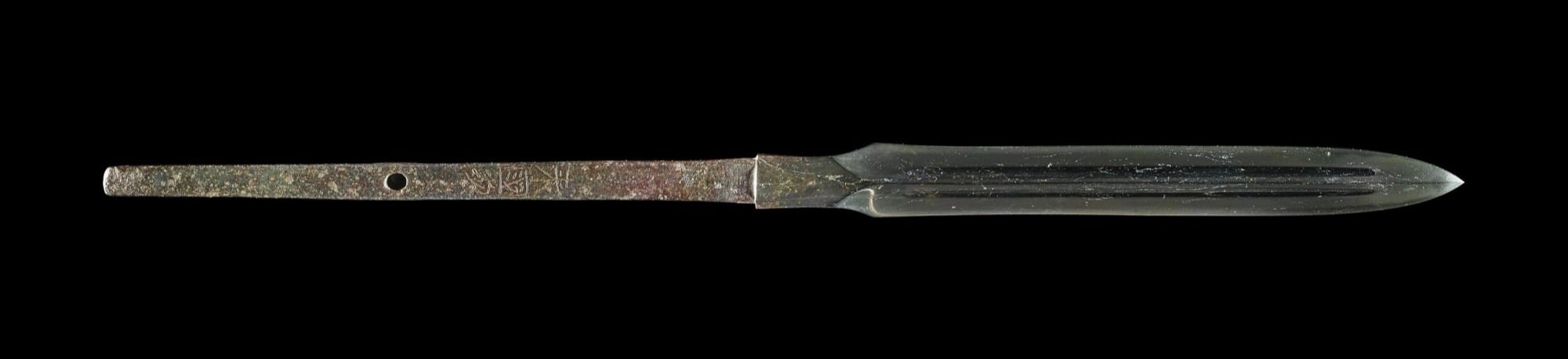
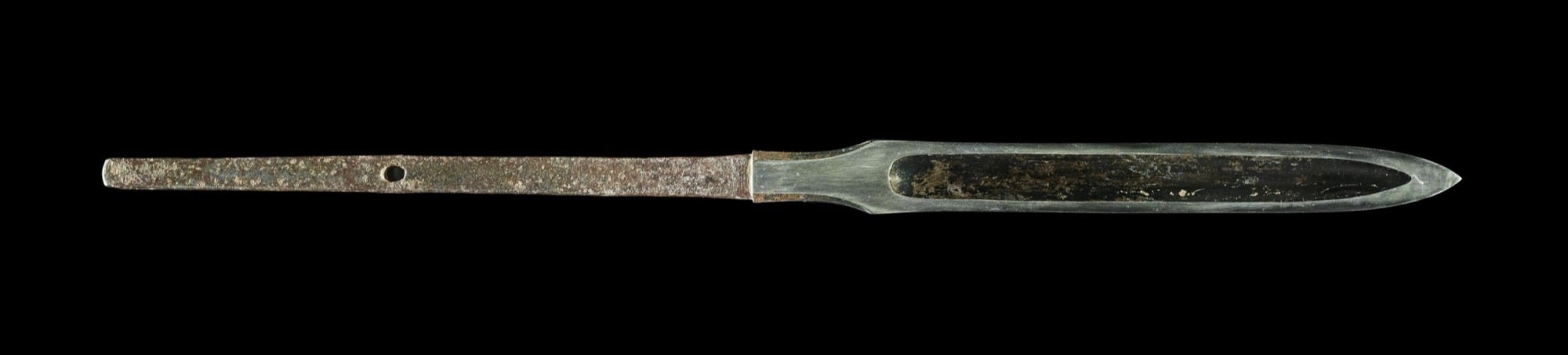
A spear at the end of his career
The Tokyo National Museum holds a yari signed 来国次 (Rai Kunitsugu). According to the museum, there is no mention of the yari before the Nanbokuchō, and an illustrated chronicle of 1323, the 『拾遺古徳伝絵』 (Shūi Kotokuden-e), already shows a similar single-edged weapon.