His style
None of the sources consulted describes his jihada, his hamon or his bōshi, or gives traits that set him apart from the other Shimosaka swordsmiths of Echizen or from the Yasutsugu house.
The Fukuoka wakizashi
The Fukuoka City Museum (福岡市博物館, Fukuoka-shi Hakubutsukan) holds a wakizashi signed 近江守藤原継廣 (Ōmi no Kami Fujiwara Tsuguhiro): a blade of 52.5 cm with 0.8 cm of sori, in shinogi-zukuri with an iori-mune and a single hole in the tang.
Nakago and mei
The signature on the omote side is 近江守藤原継廣 (Ōmi no Kami Fujiwara Tsuguhiro). On the other side, a katana bears 越前住下坂 (Echizen jū Shimosaka), and the wakizashi of 1680 the date 延宝八年五月吉日 (Enpō hachinen gogatsu kichijitsu). Both tangs have a single hole.
In the lists
In the Yamada cutting list (懐宝剣尺, Kaihō Kenjaku, 1797), Shimosaka Tsuguhiro is in the fourth grade, that of the wazamono (業物), according to the Japanese and the English Wikipedia. The grade belongs to the swordsmith, not to a particular blade. He does not appear in Tomita Kiyama’s ranking of shintō swordsmiths, according to the translation of the Japanese Sword Index. No designated work of his is recorded, nor any in the Kyōhō meibutsuchō (享保名物帳).
His signatures
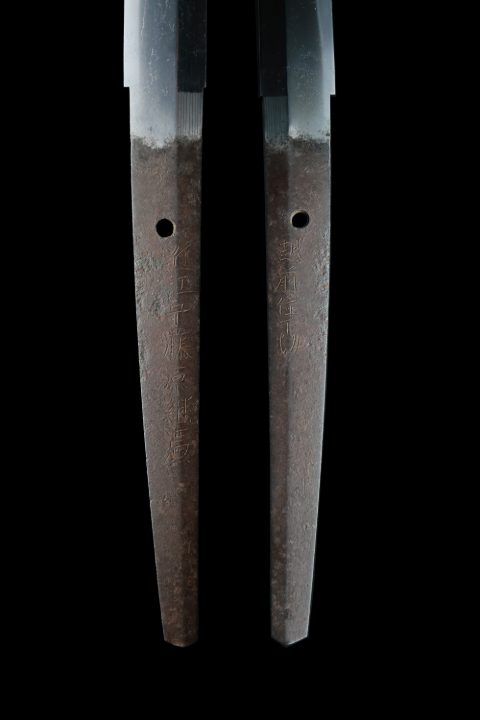
The two sides of the tang of a katana: 近江守藤原継廣 (Ōmi no Kami Fujiwara Tsuguhiro) and 越前住下坂 (Echizen jū Shimosaka). Photo: dealer in Japan 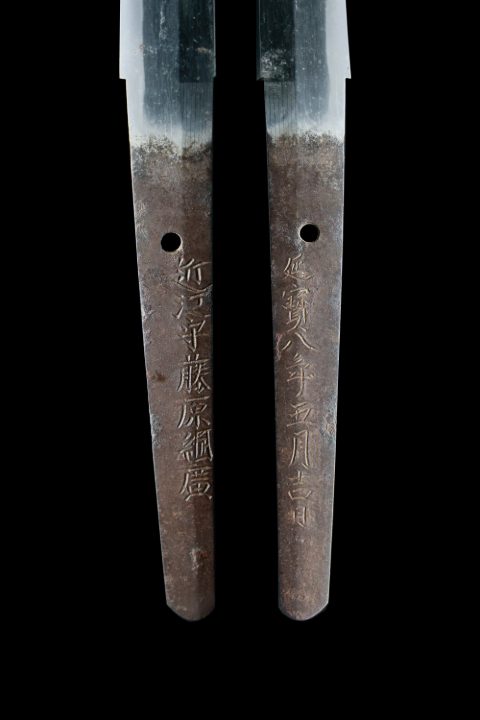
The tang of the wakizashi of 1680 (Enpō 8): the signature and the date. Photo: dealer in Japan