Suishinshi Masahide
水心子正秀 (Suishinshi Masahide)
First generation (shodai)
Swordsmith born in Dewa and settled in Edo, active from 1774 to 1825; theorist of the return to Kamakura-period blades.
Profile
Born in 1750 in Dewa, on Yonezawa domain land, he signed Terukuni (英国) as a young man. Around 1771 he trained in Hachiōji, Musashi, with the school of Shitahara (下原), and in 1774 he entered the service of the Akimoto, lords of Yamagata. From then on he signed Masahide, used the name Kawabe Gihachirō and the art name Suishinshi (水心子), and worked at the clan's forge in Edo. Around 1789 he studied the Sōshū tradition under Tsunahiro. His early work follows Osaka taste, with tōran-midare hamon; later he argued in several treatises, among them the Kenkō hidenshi (剣工秘伝志), for a return to Kamakura-period blades (fukkotō), which he put into practice in the Bizen and Sōshū traditions. He trained a large number of pupils, including Taikei Naotane and Hosokawa Masayoshi, and together with Naotane and Minamoto Kiyomaro he is counted among the Edo sansaku (江戸三作). In his last years he passed the name Masahide to his son and signed Tenshū (天秀). He died in Edo in 1825.
Swords available
-
Suishinshi Masahide
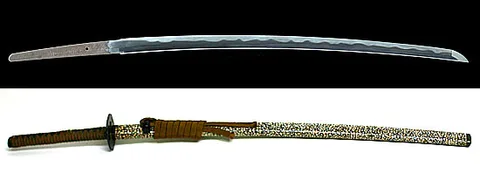
Jūyō Tōken katana by Suishinshi Masahide, signed with kaō and dated 8th month of Bunka 5 (1808), with a Sukehiro-style tōran hamon, a koshirae with shell togidashi saya and a shirasaya. Katana by Suishinshi Masahide (Kawabe Gihachirō), smith to the Akimoto clan and founding figure of the shinshintō movement, active in Musashi. The blade is shinogi-zukuri with iori-mune and chū-kissaki, with a nagasa of 69.6 cm and a sori of 1.8 cm. According to the certificate, the jihada is a tightly knit ko-itame with thick ji-nie and chikei; the hamon starts in suguha yakidashi and continues in ō-gunome mixed with notare in tōran style, with broad ashi, abundant nie, kinsuji and sunagashi and a bright nioiguchi, in the manner of the Sukehiro copies the smith pursued in his early period; the bōshi is a gentle notare with ko-maru and long kaeri. The nakago is ubu with kurijiri, ō-sujikai yasurime with keshō and a single mekugi-ana; it bears the five-character signature with kaō on the omote and the date on the ura. Designated Jūyō Tōken by the NBTHK at the 61st session (2015). It comes with a koshirae the original seller describes as a period mounting of careful workmanship: a togidashi saya with crushed shell under black lacquer and iron fittings inlaid in gold and coloured metals with gourds and rain dragons. The photographs also show the wrapped tsuka, the iron tsuba and a shirasaya.
73.1/100
€76,920