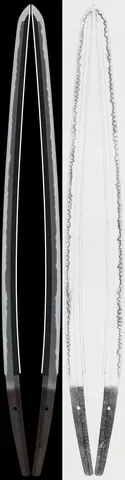
Taikei Naotane
大慶直胤 (Taikei Naotane)
Lineage: the signature does not state the generation
Swordsmith born in Yamagata, Dewa province, a pupil of Suishinshi Masahide, active in Edo in the first half of the 19th century.
Profile
Taikei Naotane, born Shōji Minobei (庄司箕兵衛) around 1778 in Yamagata, Dewa province, came from a family of blacksmiths who made farm tools. Towards the end of the Kansei era he went to Edo to train under Suishinshi Masahide (水心子正秀), and by about 1801 he was working independently. From 1812 he served the Akimoto house, lords of Yamagata and later of Tatebayashi. He received the title Chikuzen no Daijō (筑前大掾) around 1821 and that of Mino no Suke (美濃介) in 1848, when he brought a tachi to the Takatsukasa family in Kyoto. Following his teacher's call for a return to the old traditions, he worked in many styles, above all Bizen and Sōshū, and is associated with the tōran midare (濤瀾乱) hamon. He travelled widely and taught provincial smiths. From the age of fifty he sometimes added his age to the signature, and in old age he overstated it. He is counted among the Edo sansaku (江戸三作) together with Masahide and Minamoto Kiyomaro. His pupil Jirōtarō Naokatsu (次郎太郎直勝), who married his daughter, became his successor. Naotane died in 1857. Works of his are held in museums in Japan.
Swords available
-
Soushi Chikuzen Daijo Taikei Naotane
Shinshintō katana by Taikei Naotane, signed with kaō and dated Bunsei 12 (1829), showing utsuri, with a complete shakudō koshirae, shirasaya and NBTHK Tokubetsu Hozon Tōken. Katana by Taikei Naotane (Shōji Naotane), a shinshintō smith whom the original seller ranks as saijō-saku, pupil of Suishinshi Masahide and active in Edo (Musashi). According to the original seller he was born in Dewa province, received the title Chikuzen Daijō around Bunsei 4 and that of Mino no Kami in Kaei 1, and mastered both the Bizen and the Sōshū traditions. The blade has a nagasa of 68.64 cm and a sori of 1.21 cm; it is broad and thick, with an elongated kissaki. The seller describes a koitame jigane with ji-nie and chikei showing utsuri, unusual in late Edo work, and a nie-based hamon of chōji-midare mixed with gunome-midare, with abundant ashi and kinsuji; the bōshi is midarekomi with a round turnback. In the photographs the tang is ubu, with a single mekugi-ana, signed “Sōshi Chikuzen Daijō Taikei Naotane” with kaō and dated the second month of Bunsei 12 (1829). It comes in shirasaya together with a complete koshirae: mokkō-shaped shakudō tsuba with plant motifs, shakudō fuchi-kashira with arabesques, menuki and kurigata bearing the kuyō-mon, shakudō kojiri and a saya lacquered in red and black. It holds an NBTHK Tokubetsu Hozon Tōken certificate, photographed, and comes with a box.
68.5/100
€23,740