Takada Muneyuki
高田統行 (Takada Muneyuki)
First generation (shodai)
First Muneyuki of the Takada school, a Bungo swordsmith active around the Tenshō era, in the last quarter of the 16th century.
Profile
Muneyuki belonged to the Takada school, the group of smiths based at Takada in Bungo province, near present-day Ōita. Reference works trace the school back to Tomoyuki (友行), of the line of Sa (左) of Chikuzen, in the Nanbokuchō period; by the late Muromachi period, under the patronage of the Ōtomo, its output rivalled that of Bizen and Mino. Two smiths named Muneyuki are distinguished: this one, the first, worked around the Tenshō era (1573-1592); the second between Keichō and Kan'ei. School tradition holds that the character mune (統) in his name was granted by the Ōtomo, lords of Bungo. The name Muneyuki is linked to the school's shift to signing with the surname Fujiwara (藤原), which sets the Edo-period Takada smiths, known as Fujiwara Takada, apart from the Taira Takada (平高田) of the Muromachi period. The Takada smiths made practical, solidly built blades for the warriors of Kyūshū.
Rankings
- Wazamono (good) (Kaihō Kenjaku, 1797)
Swords available
-
Hōshū Takada-jū Fujiwara Muneyuki
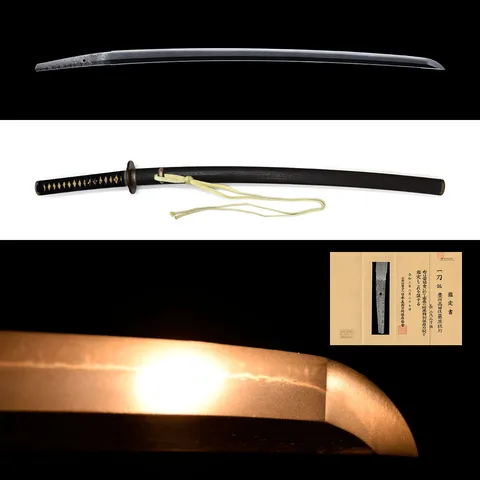
Work of the second generation Muneyuki of the Takada school of Bungo, with an untouched single-hole tang and an unusual saya: a net stretched over it, lacquered and polished to a honeycomb. The Takada school of Bungo begins in the Nanbokuchō period with Tomoyuki, a pupil of Sa Monji of Chikuzen. Kotō blades sign with the Taira surname and, from the shintō period onwards, with Fujiwara. It is a school with a long reputation for working swords: during the Sengoku it forged for Ōtomo Sōrin and rivalled Seki and Osafune in output. Muneyuki, civil name Nakama Shingorō, received a character of his name from the daimyō Ōtomo Yoshimune, is regarded as the founder of Takada shintō and is classed wazamono. This blade is attributed to the second generation: a strong shape with broad saki-haba and an extended point, a slightly dark ko-itame hada with flowing grain and faint utsuri, a tight, luminous suguha with occasional ko-notare, frequent ashi and yō of archaic feel, and a straight bōshi with a broad, round turnback. It measures 69.9 cm nagasa with 1.22 cm sori, motohaba 30.8 mm and motokasane 7.2 mm; it weighs 704 g bare and 1,037 g mounted. The koshirae is uchigatana in kuro-rō-nuri with a kawari ami-maki saya: a net was stretched over the scabbard, lacquered over and polished back to leave a honeycomb pattern. The fittings form an isshin set in shibuichi migaki-ji. Shirasaya and tsunagi are included.
62.7/100
€8,440