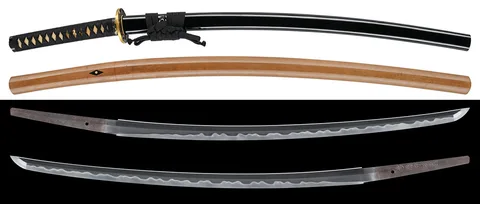
Tango no Kami Kanemichi
丹後守兼道 (Tango no Kami Kanemichi)
Lineage: the signature does not state the generation
Lineage of Mishina school swordsmiths based in Osaka, Settsu province, active from the first half of the 17th century.
Profile
Tango no Kami Kanemichi (丹後守兼道) is the name signed by several generations of the Osaka branch of the Mishina (三品) school. The founder of the line was a son of the Kyoto smith Tanba no Kami Yoshimichi; he first signed Naomichi, received the title Tango no Kami in the Kan'ei era and settled in Osaka, where he died in 1672. His son Kiheiji (喜平次) followed him as second generation around the Genroku era, and the name stayed in the family through the 18th century. The first generation cut a chrysanthemum crest, kikumon (菊紋), together with the character ichi (一) on the tang. The line's work joins the Kyoto inheritance of chōji and gunome midare with ample nie and sudare-ba (簾刃), whose sunagashi call to mind a bamboo blind, with the suguha and calm notare of Osaka; the second generation took up the deeper-curved Genroku shape and the straight Osaka yakidashi. Since the signature repeats, the generation is told apart by shape, style and the details of the inscription.
Swords available
-
Tango-no-kami Kanemichi, second generation
Shintō katana from Settsu (Osaka), signed Tango-no-kami Kanemichi, with an ubu tang, NBTHK Tokubetsu Hozon paper, shirasaya and a koshirae with a black lacquered saya. According to the original seller, this is the work of the second-generation Tango-no-kami Kanemichi, son of the first, of the Mishina family, with dated works from around Genroku and Hōei; he is told apart from his father because he does not cut the character "ichi" or the chrysanthemum on the tang. The blade, 69.3 cm long with 2.1 cm of sori, is shinogi-zukuri with an iori-mune, a wide mihaba and a slightly extended chū-kissaki. The seller describes a fine ko-itame with ji-nie and chikei, and a hamon that starts in suguha and continues in grouped gunome mixed with notare, in tōran style, with thick ashi and deep nie-nioi; the bōshi runs straight with a round turn-back. The photographs show a clean polish and the full hamon on both sides. The tang is ubu, with keshō-sujikai yasurime, a single mekugi-ana and the signature 丹後守兼道 (Tango no Kami Kanemichi). It comes with a 2024 NBTHK Tokubetsu Hozon Tōken origami, the shirasaya, a gold-foiled two-piece habaki and an uchigatana koshirae: black roiro-lacquered saya, pierced iron tsuba with warriors beneath a pine and a gilt rim, fuchi with water plants and a dragonfly, and a tsuka in black ito over full-wrap same.
52.1/100
€21,070