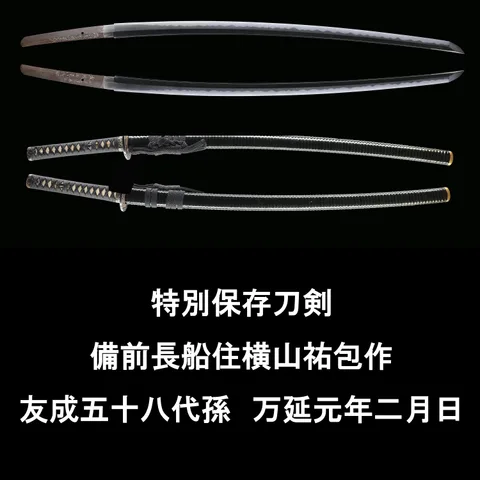
Yokoyama Sukekane
横山祐包 (Yokoyama Sukekane)
Lineage: the signature does not state the generation
Smith name of the Yokoyama of Osafune in Bizen, used in the shinshintō period, from the 19th century into the early Meiji years.
Profile
Sukekane (祐包) is a smith name of the Yokoyama of Osafune in Bizen, the family that carried the Sukesada line into the 19th century. Its first and principal bearer was adopted into the family and worked from the 1830s into the early Meiji years; together with Sukenaga, he is counted among the smiths who kept the Bizen tradition going in that period. He favoured long signatures such as Bizen no kuni Osafune-jū Yokoyama Sukekane saku, often adding Tomonari gojūhachidai-son (友成五十八代孫), "58th-generation descendant of Tomonari", following the genealogy the family claimed. His hada is a very tight ko-itame, almost without visible pattern, and his hamon a kobushi-type chōji with a tight nioiguchi. Miyamoto Kanenori (宮本包則) trained under him and took the character kane (包) from his name. School tradition mentions a second Sukekane, a pupil of his, and blades bearing his signature made by Sukeharu (祐春) are known; the signature alone does not always tell which of them made a blade.
Swords available
-
Yokoyama Sukekane
Katana by Yokoyama Sukekane of Bizen Osafune, signed and dated 1860, with NBTHK Tokubetsu Hozon papers and a complete koshirae that the original seller describes as a period mounting. Katana by Yokoyama Sukekane, a smith of Osafune in Bizen who, according to the original seller, carried on the Sukesada line and styled himself the 58th-generation descendant of Tomonari; his known work spans roughly 1834 to 1872. The blade has a nagasa of 72 cm and a sori of 2.2 cm, with a motohaba of 3.17 cm and a kasane of 0.67 cm. The seller describes a well-forged ko-itame jigane with ji-nie and a nioi-deki hamon of chrysanthemum chōji, with abundant ashi and a bright nioiguchi. The nakago, intact according to the photographs and with a single mekugi-ana, is signed «Bizen Osafune jū Yokoyama Sukekane saku» and, on the ura, «Tomonari gojūhachi-dai mago» with the date of the 2nd month of Man'en 1 (1860). The photographs show a complete koshirae, which the seller describes as a period mounting: senda-kizami lacquered saya with mother-of-pearl, an iron tsuba with a shakudō rim depicting Kōsekikō and Chōryō, shakudō menuki of the peaches of the immortals and a signed fuchi-kashira with warriors from the Tamagawa school of Mito. It is accompanied by an NBTHK Tokubetsu Hozon Tōken certificate from 1983.
70.1/100
€17,230