Doi Shinryō
土肥真了 (Doi Shinryō)
Hirado smith from Hizen who studied under Inoue Shinkai in Osaka around 1680 and then served the Matsura; active in the late 17th century.
Profile
Doi Shinryō came from Hirado in Hizen province and was the son of a local swordsmith. Around 1680 he went to Osaka to study with Inoue Shinkai (井上真改); by tradition he received from his teacher the character shin (真) in his name, and an earlier name, Masashige (正重), is attributed to him for his first works. After Shinkai died in 1682 he returned to Hirado and entered the service of the Matsura, lords of the domain. His blades keep close to the Osaka manner: broad and of good thickness, with ko-itame and ji-nie and a nie-based hamon, either a suguha that undulates gently or notare with gunome, with a deep, clear nioiguchi; blades in a midare closer to Tsuda Sukehiro are also known. He signed Doi Shinryō (土肥真了). His successors in Hirado kept the name and the same signature through the 18th century, so the date is often what tells the generations apart. Hirado Castle has exhibited a blade of his dated 1685 alongside one by the third generation dated 1753.
Rankings
- Wazamono (good) (Kaihō Kenjaku, 1797)
Swords available
-
Doi Shinryō, 3rd generation
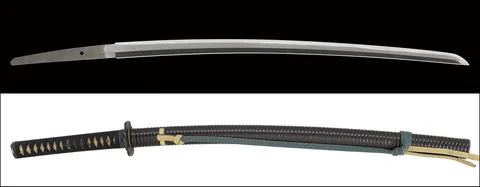
Katana signed and dated Meiwa 5 (1768) by Doi Shinryō, of the Hirado line that carried on Inoue Shinkai's style, with an ubu nakago, Tokubetsu Hozon paper and a Bakumatsu mounting. Katana by Doi Shinryō, a Hirado (Hizen) lineage founded by Doi Masashige, who studied under Inoue Shinkai in Osaka and received the character "Shin" from him. For generations the school kept to Shinkai's manner, with a bright suguha-notare. According to the original seller, the Meiwa 5 date places the work in the third or fourth generation, and he leans towards the late years of the third. Shinogi-zukuri blade with a low iori-mune and chū-kissaki; nagasa 69.2 cm, sori 1.5 cm. The seller describes a well-forged itame mixed with mokume, thick ji-nie and chikei, and a ko-nie suguha-notare hamon with ashi, yō, kinsuji and sunagashi; old polish. The photographs show an ubu nakago with kurijiri, ō-sujikai yasurime and a single mekugi-ana, signed "Doi Shinryō" on the omote and dated on the ura. Uchigatana mounting dated by the seller to the Bakumatsu: black roiro kizami saya, oyazame tsuka with black ito, iron mokkō tsuba with a dragon in sukidashi-bori and gold zōgan, signed shakudō fuchi-kashira and dragon menuki. NBTHK Tokubetsu Hozon paper dated 1 December, Reiwa 7 (2025).
82.2/100
€15,700