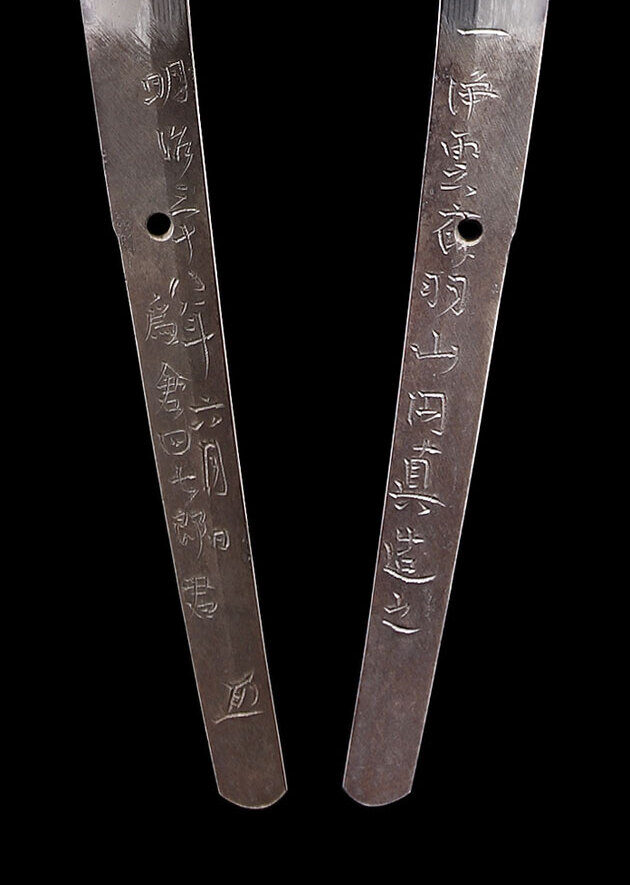
Training
- He was born in 1845 (弘化二年, Kōka ninen), son of a samurai of the Toyohashi domain, also called Yoshida, in present-day Aichi Prefecture.
- A summary in English has him born in Edo; the other sources say Toyohashi.
- A samurai himself, he became a swordsmith and entered as a pupil of 鈴木正雄 (Suzuki Masao), one of the best pupils of 源清麿 (Minamoto Kiyomaro), in Edo.
- He opened his forge in Yanaka-Shimizu-chō, in the 下谷 (Shitaya) district. He first signed 正寛 (Masahiro) and took the name 浄雲斎 (Jōunsai).
The commissions
- He is said to have forged the sword of 大村益次郎 (Ōmura Masujirō); only one source says so.
- In 1897 Prince 伏見宮貞愛 (Fushimi-no-miya Sadanaru) commissioned from him a replica of the sword 小烏丸 (Kogarasu-maru), and from then on he devoted himself to copying old swords. This too comes from only one source.
- In 1902, at the age of fifty-seven, he forged a 毛抜形蕨手刀 (kenukigata warabitetō), with the blade and the iron hilt in one piece and the signature on the hilt.
- In 1909 he forged at the 熱田神宮 (Atsuta Jingū) shrine, in Nagoya, at the age of sixty-four.
- He was called “the Masamune of Taishō” for one of his swords, and he was a master of the cutting test (試し斬り, tameshigiri).
Admiral Tōgō’s katana
Between 1913 and 1914 he forged a sword from the Western steel Tōgō Hagane of the Kawai house: a steel from the British firm Andrew that took the admiral’s name after 1905. In 1914 it was tested by splitting a helmet in two, and it was given to Admiral 東郷平八郎 (Tōgō Heihachirō), who gave thanks with his portrait and a walking stick.
The last of his school
He died on 14 February 1920, at the age of seventy-five. With 月山貞一 (Gassan Sadakazu), who died in 1918, and 宮本包則 (Miyamoto Kanenori), in 1926, the last swordsmiths of shinshintō were gone.