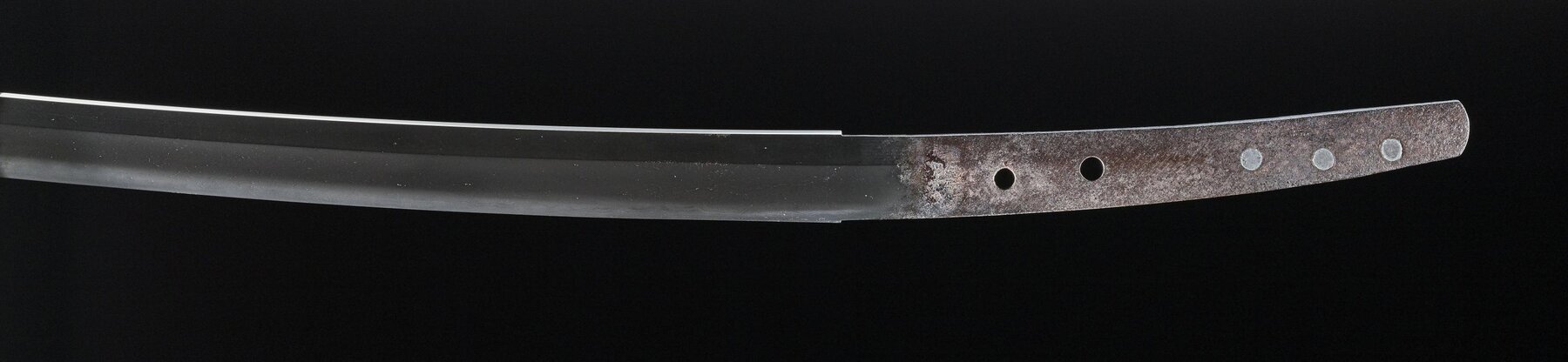
Son of Norimune
- Kotobank gives him as the son of Norimune, the founder of the Fukuoka Ichimonji school; the Japanese Wikipedia, more cautious, says that he is “said to be” Norimune’s son.
- Kotobank gives him the title 修理亮 (Shuri no suke) and the name 大一文字 (Ō-Ichimonji). His dates are not known.
Rotating swordsmith of Go-Toba
- In 1208 he served as a rotating smith, 御番鍛冶 (goban-kaji), of the retired emperor Go-Toba. In the list of the thirteen rotating smiths, one per month, he holds the ninth month; Norimune has the first, and almost all of them are from Fukuoka.
- Already in the Muromachi period forgeries of his blades circulated with a chrysanthemum engraved on the nakago and deliberately worn down, as if the polishing had erased it. So says the Nōami-bon Meizukushi, quoted by Markus Sesko.
Shimada, in Suruga
- The Japanese Wikipedia records a tradition of the city of Shimada: the Shimada school of Suruga would descend from an Ichimonji Sukemune of Bizen, Go-Toba’s rotating smith, who lived in Gojō, in Kyoto, and moved to Shimada; a descendant of his would have been the first 義助 (Yoshisuke).
- It is a local tradition, not a documented fact. The same Wikipedia warns that the real first Yoshisuke seems to be the one the tradition counts as the fourth, in the service of Imagawa Yoshitada.
- According to the same Wikipedia, a brother of that first Yoshisuke took the name Sukemune, and from the Meiō era there were three generations: they are the Shimada Sukemune, other smiths.