Iga no Kami Kinmichi
伊賀守金道 (Iga no Kami Kinmichi)
Lineage: the signature does not state the generation
Line of swordsmiths of the Mishina school in Kyoto (Yamashiro), active from the late 16th century and throughout the Edo period.
Profile
Iga no Kami Kinmichi was the name carried through the whole Edo period by the senior branch of the Mishina school in Kyoto. The first of the line was the eldest son of Kanemichi (兼道), a Seki smith from Mino who moved to Kyoto with his sons around 1593; he received the title Iga no Kami in 1594 and died in 1629. Tradition holds that Tokugawa Ieyasu ordered a large number of tachi from him before Sekigahara, and that this earned him the title Nihon Kaji Sōshō (日本鍛冶惣匠), 'master of the swordsmiths of Japan', together with the right to chisel the imperial chrysanthemum on the tang. It was more than an honour: the house acted as intermediary at court when other smiths applied for titles. The second generation began adding it to the signature, and the third replaced the character 惣 (sō) with 宗 (sō). Since name and signature passed from father to son, the signature alone does not always tell which generation made a blade. Typical of the school are ko-itame with masame, gunome midare and the so-called Mishina bōshi (三品帽子), with a pointed turn-back.
Swords available
-
Iga no Kami Fujiwara Kinmichi II
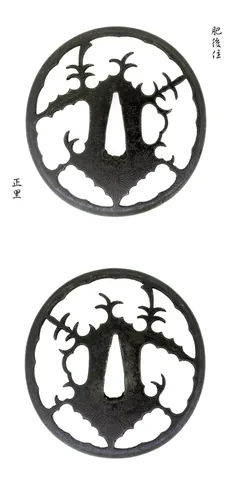
Katana by the second-generation Iga no Kami Kinmichi (Mishina school, Kyoto), with imperial chrysanthemum and signature on an ubu tang, NBTHK Tokubetsu Hozon paper and an uchigatana koshirae with a tsuba signed Higo-jū Masasato. Katana by the second-generation Iga no Kami Fujiwara Kinmichi, head of the Mishina school in Kyoto, who received his title in Kan'ei 14 (1637) and from then on engraved the imperial chrysanthemum on his tangs; the original seller places the sword in the early Edo period. The blade has a nagasa of 74.5 cm and a sori of 1.8 cm; according to the original seller, the hada is itame with masame in the shinogi-ji and abundant ji-nie, and the hamon opens with a long Kyoto-style yakidashi before running in notare with gunome, togari-ba, hako-ba and yahazu-ba, with a Mishina bōshi. The tang is ubu with a single mekugi-ana, katte-sagari yasurime and a kengyō tip; above the hole it bears the sixteen-petal chrysanthemum and below it the signature Iga no Kami Fujiwara Kinmichi, visible in the photographs. It comes with an uchigatana koshirae: a scabbard lacquered in vermilion tame-nuri with broad stripes (yatara), a tsuka of white same with hishimaki wrap, fuchi-kashira in shakudō nanako with gold kiri-mon, crane menuki and an openwork iron tsuba with paulownia motifs signed Higo-jū Masasato, with an NBTHK Hozon Tōsōgu paper; gilt habaki and shirasaya are also included. The blade holds an NBTHK Tokubetsu Hozon Tōken certificate, legible in the photographs.
71.8/100
€17,630