What he is after
- He calls his work “the beautiful world of the Sōshū-den” (美しい相州伝の世界, utsukushii Sōshūden no sekai), and he also makes blades in suguha.
- For him, a famous sword must be like a beautiful woman: an elegant sugata, a clear jihada with depth (ji-nie, chikei) and a white, crisp hamon.
- He makes his own steel (oroshigane) from hachime-zuku (蜂目銑, hachime-zuku) from old tatara furnaces dating from before the middle of the Edo period and from old San’in iron, and he wants it “sensitive and with a beautiful nie”.
- A 2022 interview places him among those who reach highest in the Sōshū-den and says that his work is often called “seductive” (色っぽい, iroppoi); he sees himself as an artist (作家, sakka) rather than a craftsman.
The 2014 katana
The catalogue of the Heisei no Meitō Meikōten (2019) describes his prize-winning katana: signed 晶平之 (Akihira kore) and dated 平成甲午年二月日 (Heisei kōgo-doshi nigatsu hi), February 2014; 76.7 cm nagasa and 2.6 cm sori. It was polished by Abe Kazuki (阿部一紀), the habaki is by Nakata Kōji (中田晃司) and the saya by Mori Takahiro (森隆浩).
Known works
- The “Counter Sword” of the exhibition “Evangelion and the Japanese sword” (2012), which later travelled to Spain (2014).
- The guardian sword of the ambassador of Poland (2016).
- The commemorative tantō for the 150th anniversary of the Yasukuni shrine (2018).
Gallery of works
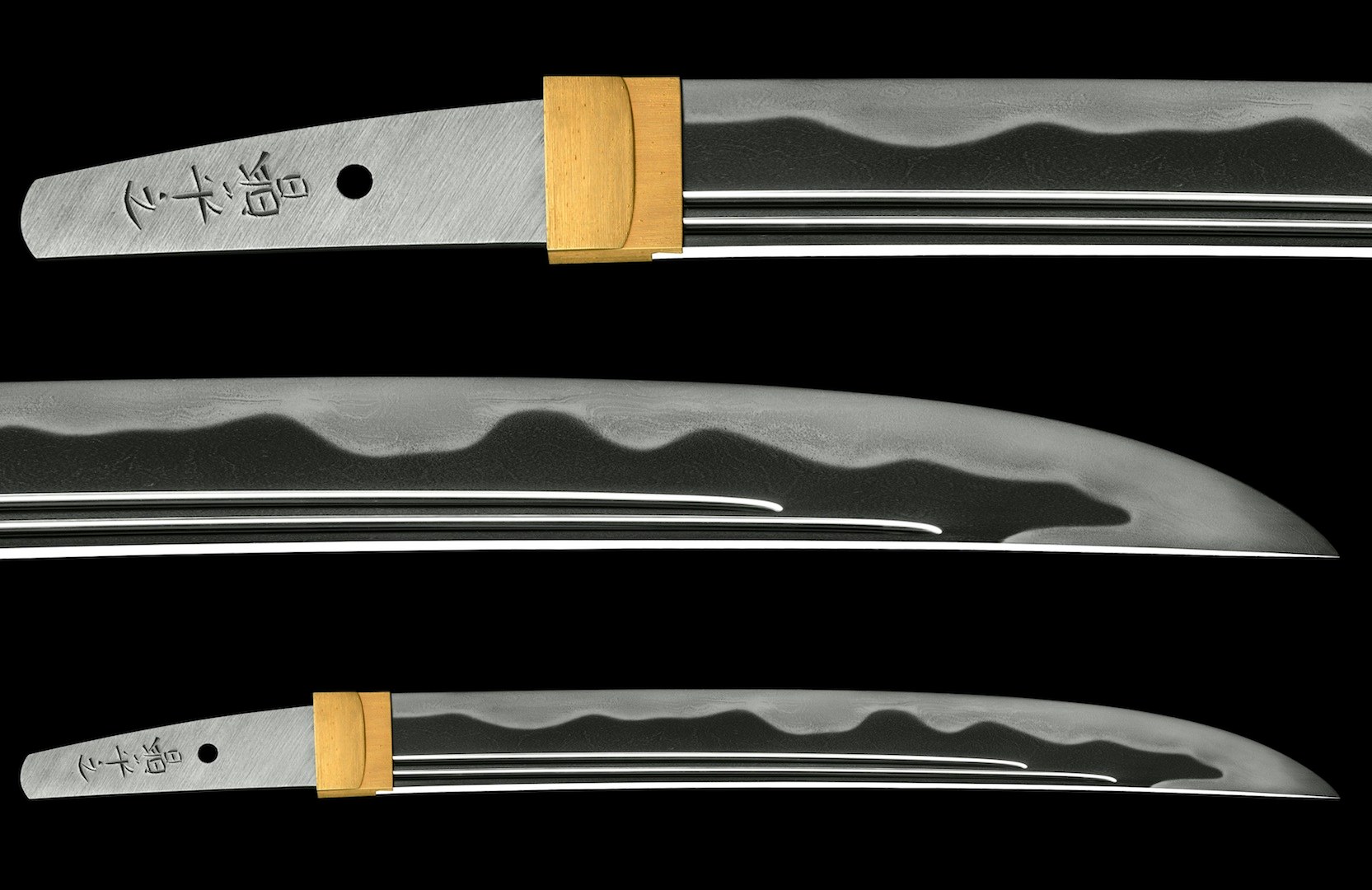
A short blade of his, signed 晶平之 (Akihira kore), with a notare hamon. Photo: the smith himself 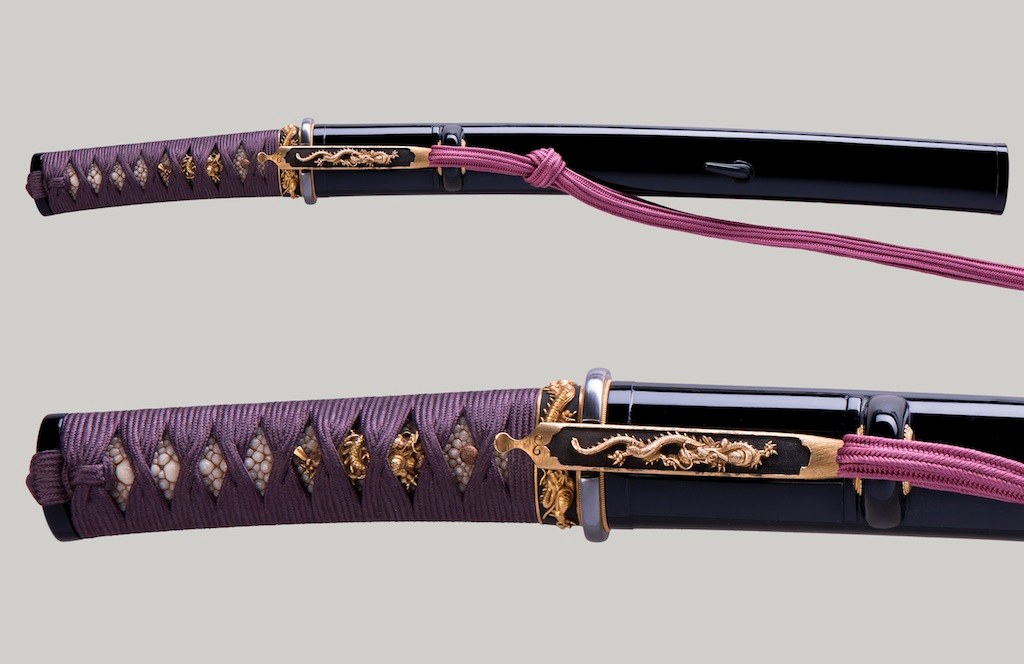
A mounting with a purple cord-wrapped hilt and a black-lacquered scabbard. Photo: the smith himself 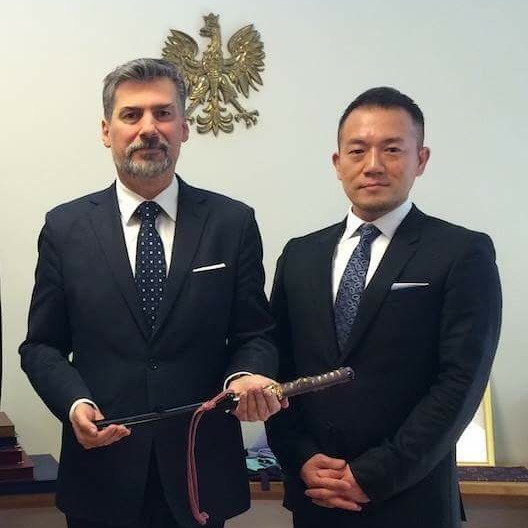
The presentation of the guardian sword to the ambassador of Poland, in 2016. Photo: the smith himself