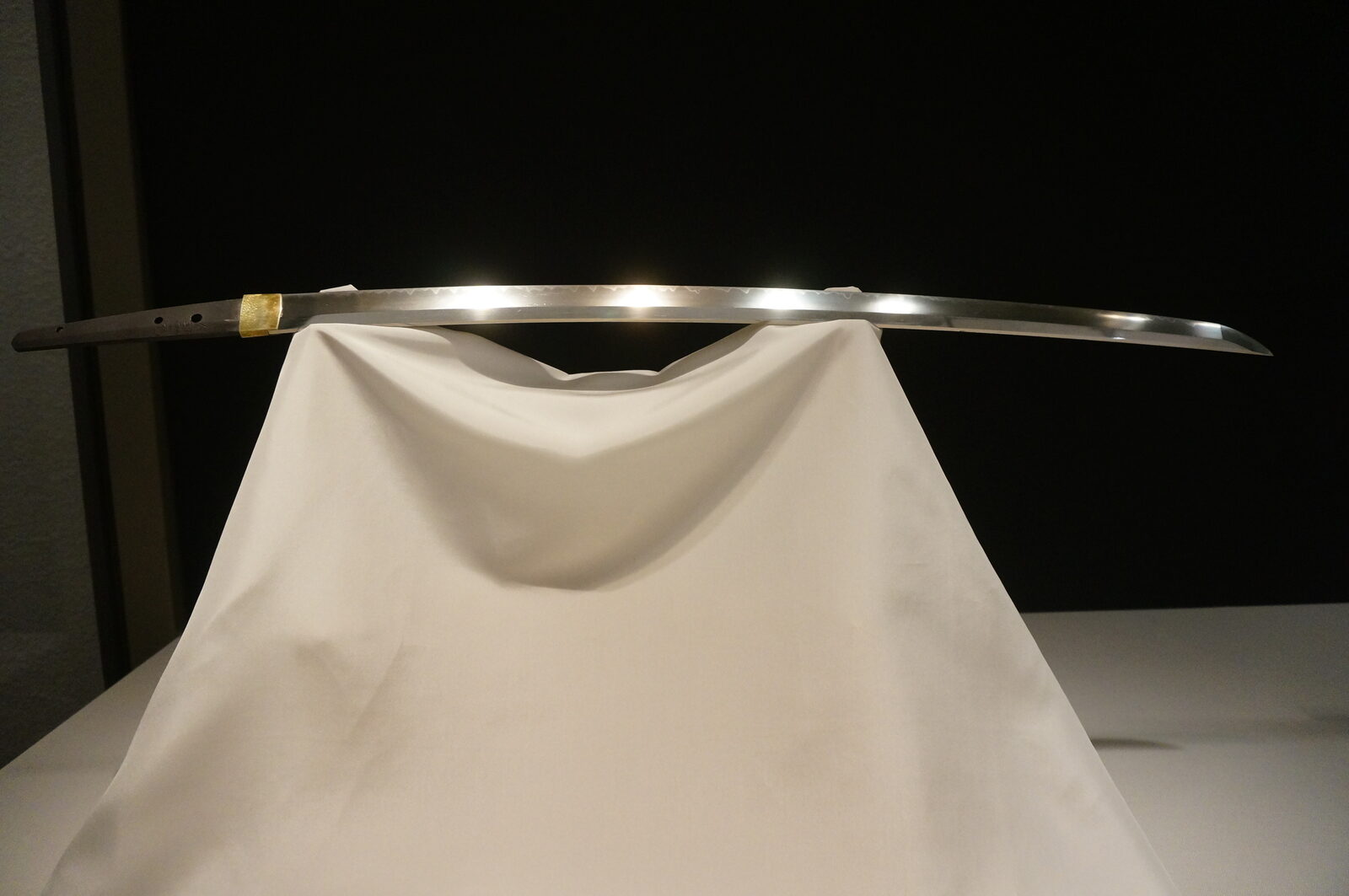
The Aoki Kanemoto
- The 青木兼元 (Aoki Kanemoto), also called 真柄切 (Magara-giri), is the uchigatana with which, according to tradition, Aoki Kazushige killed Magara Naotaka at the battle of Anegawa, in 1570.
- It has been an Important Art Object (重要美術品, jūyō bijutsuhin) since 6 September 1939, as “刀 銘兼元 (katana mei Kanemoto)”, when it belonged to Viscount Niwa Naganori. Today it is in a private collection.
- It measures 70.6 cm, with 1.51 of sori; it bears the two-character signature on the omote face and a temper described as the sanbonsugi of Seki no Magoroku.
In the museums
- Tokyo National Museum: a katana by Seki (Magoroku) Kanemoto of the 16th century, the one in the photos of this monograph, with no designation indicated.
- Tokyo National Museum: a tantō signed “濃州赤阪住兼元作 (Nōshū Akasaka-jū Kanemoto saku)”, with its mounting. Its record does not say which generation of Kanemoto it is by.
- The Metropolitan Museum of Art, New York: a blade signed by Kanemoto Magoroku, of the 16th century, of 74.5 cm, bequest of George C. Stone in 1935 (36.25.1655a-d).
Blades of the tradition
- The 二念仏兼元 (Ninenbutsu Kanemoto), of the Maeda house, famous for its cutting. The sources consulted do not say where it is or whether it has a designation.
- Mishima Yukio’s katana, the one he carried in the Ichigaya incident, is held to be a Seki no Magoroku and is certified as “Seki Kanemoto”; the Japanese Wikipedia warns that it could be by a later Kanemoto, of the Genroku era.
In the cutting list
- The 懐宝剣尺 (Kaihō Kenjaku) of 1797 places Kanemoto I, Seikan Kanemoto (清関兼元, Seikan Kanemoto), and Kanemoto II, Magoroku, in the highest grade, saijō ōwazamono. The English Wikipedia counts in that grade 12 swordsmiths in the original list and 15 after the revision of 1830.
- The Japanese Wikipedia sums it up thus: “古刀最上作にして最上大業物” (kotō saijō-saku ni shite saijō ōwazamono), among the best of the kotō and of the supreme cutting grade.