His works, one by one
| Work | Designation | Where it is | Note |
|---|---|---|---|
| Tantō 銘則重 (mei Norishige), called Nihon-ichi (日本一, Nihon-ichi) | Important Cultural Property (19 January 1931) and National Treasure (14 November 1953) | Eisei Bunko (永青文庫, Eisei Bunko), Tokyo; 24.6 cm | His most celebrated work |
| Tachi 銘則重 (mei Norishige) | Important Cultural Property | Fujishima shrine (藤島神社, Fujishima Jinja), Fukui | Its official record is missing |
| Tantō 銘則重 (mei Norishige) | Important Cultural Property | Ōkura Shūkokan (大倉集古館, Ōkura Shūkokan), Tokyo | Its official record is missing |
| A tachi, two unsigned attributed katana, a katana with a gold-inlaid signature and three more tantō | Important Cultural Properties | Private and corporate collections; some of unknown whereabouts | One, from the Kagoshima Jingū, confiscated after the war |
| Unsigned tachi, attributed to Norishige | Jūyō Bijutsuhin | Private collection; from the Ikeda of Bizen | A gift from the shōgun Iemitsu to Ikeda Mitsumasa |
| Tantō 銘則重 (mei Norishige) | Not designated; Kamakura period, 14th century | Kyoto National Museum | A work by Norishige of Etchū, according to the museum |
| Tantō with the inscription 越中御服住伯則重 (Etchū Gofuku-jū Haku Norishige) | Not designated | Tokyo National Museum | The inscription is not the usual signature with Saeki: authorship to be checked |
The Nihon-ichi tantō
The official record of the Agency for Cultural Affairs and NBTHK Sword Journal no. 794 describe it as hira-zukuri, with iori-mune and takenoko uchizori, with a jigane of ko-itame mixed with matsukawa-hada. It measures 24.6 cm, with a motohaba of 1.97 cm; it has a wide hamon rich in nie, with kinsuji and sunagashi, a midare-komi bōshi with hakikake like a flame, and a nakago almost ubu, furisode, with a kurijiri tip, three mekugi-ana and the large two-character signature.
It belonged to Sugiyama Shigemaru, who gave it a wooden tag with the name “Nihon-ichi”, “the number one in Japan”; in 1932 it was bought by Hosokawa Moritatsu, the first president of the NBTHK. It was exhibited at the Eisei Bunko from 14 January to 7 May 2023. The name was given by a modern owner; it is not from the Kyōhō meibutsuchō.
In the lists
- 正宗十哲 (Masamune jittetsu). He is one of Masamune’s ten pupils on the traditional list: Sadamune, Kanemitsu of Bizen, Chōgi, Samonji, Rai Kunitsugu, Hasebe Kunishige, Gō Yoshihiro, Norishige of Etchū, Shizu Saburō Kaneuji and Kinjū of Mino, or in his place Sekishū Naotsuna. The Japanese Wikipedia warns that, by their dates, not all of them were direct pupils.
- 古刀最上作 (kotō saijō-saku). The Japanese Wikipedia places him among the best of the kotō, without saying which edition of the scale.
- Wazamono. Norishige does not appear in Yamada Asaemon’s ranking of sharpness (業物, wazamono), according to the list in the Japanese Wikipedia.
- Kyōhō meibutsuchō (享保名物帳, Kyōhō meibutsuchō). It has not been checked whether any blade of his appears in it under its own name.
In the museums
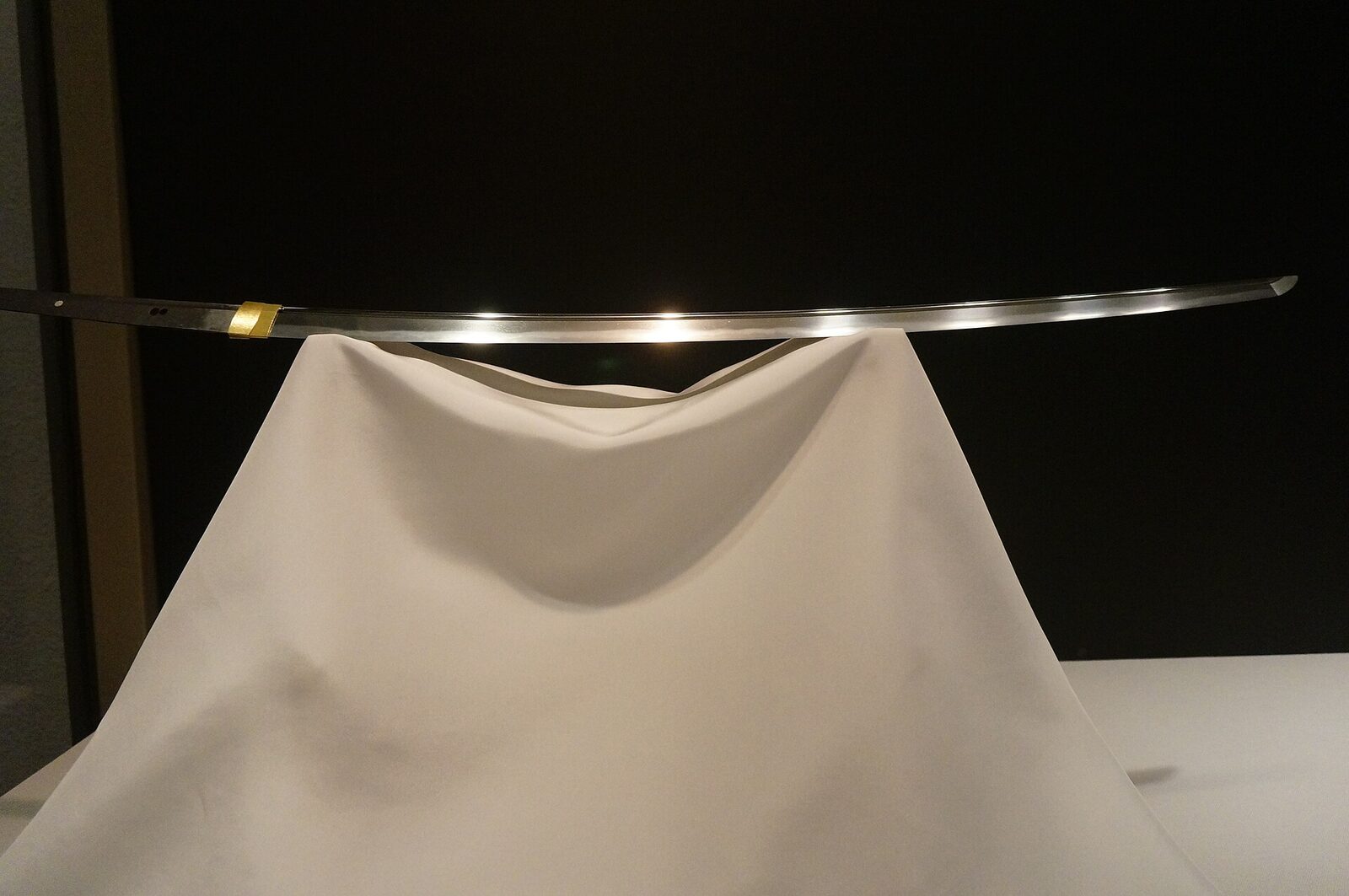
Tachi by Norishige on display, according to the title of the photo. SLIMHANNYA, CC BY-SA 4.0, via Wikimedia Commons · CC BY-SA 4.0 · source 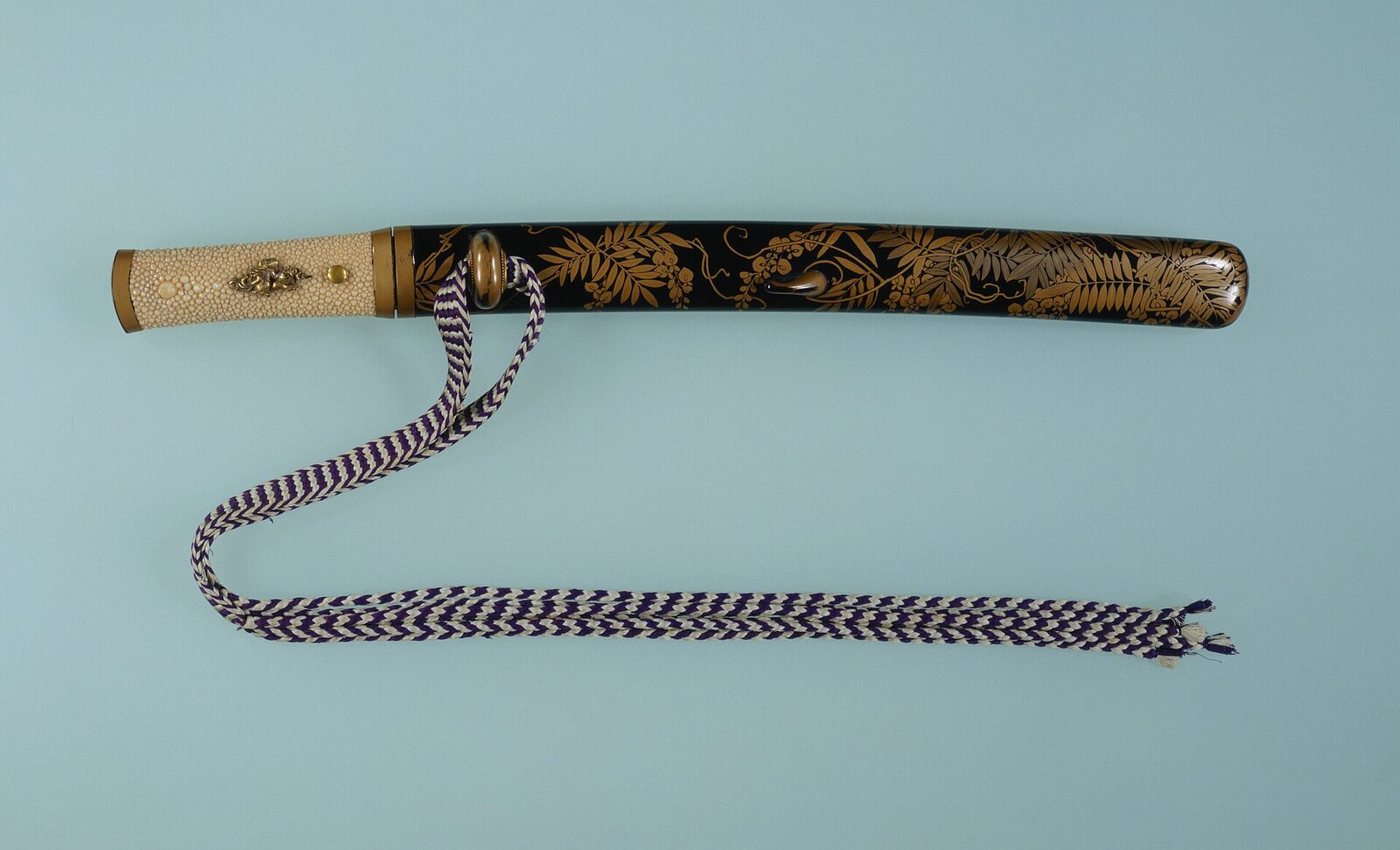
The aikuchi mounting, in black lacquer with wisteria, of the Norishige tantō in the Tokyo National Museum; the blade is not visible. Tokyo National Museum, CC BY 4.0, via Wikimedia Commons · CC BY 4.0 · source

